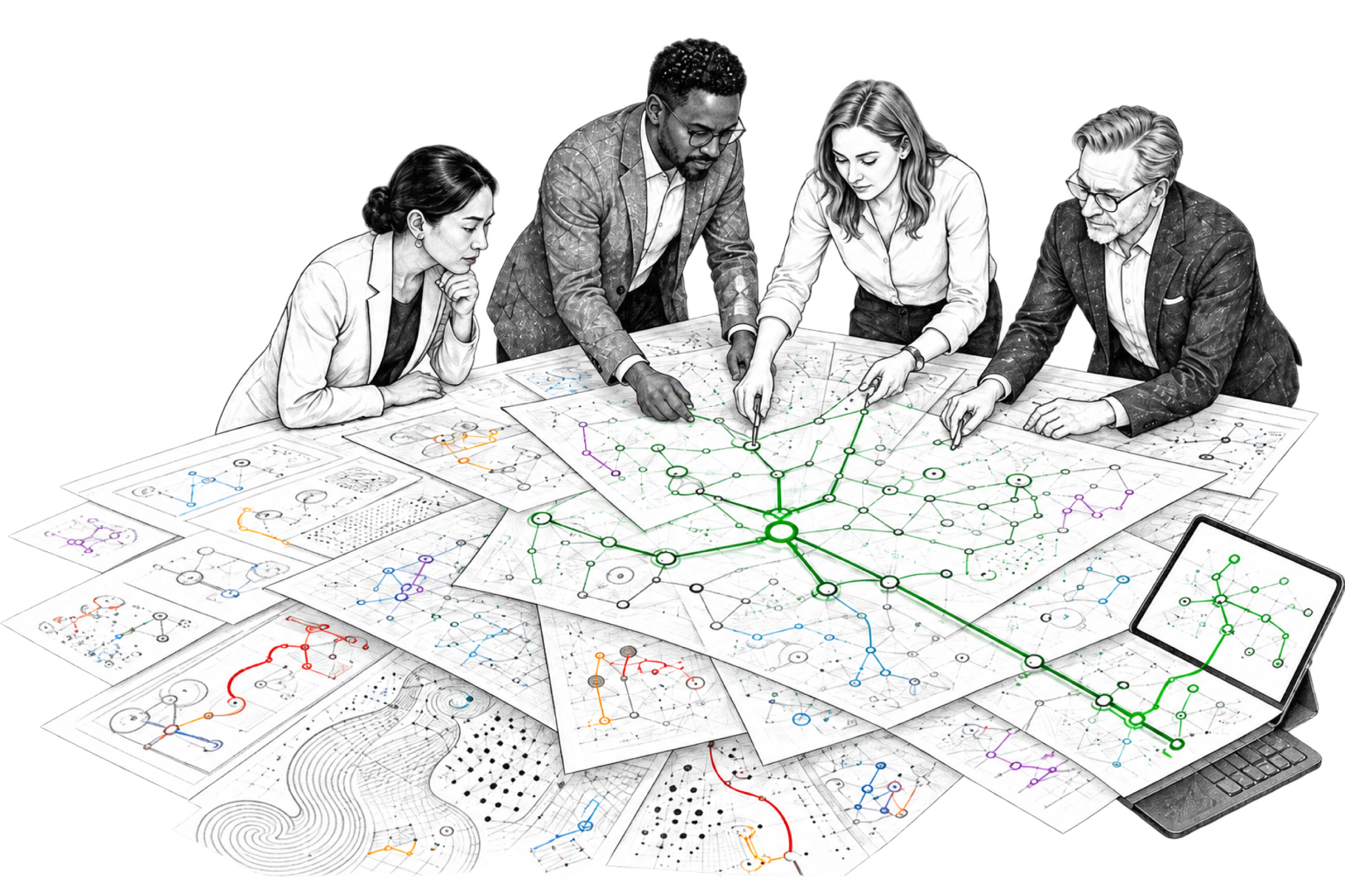
Two decades in consulting and leadership showed us capable, well-intentioned groups committing to important decisions — and repeatedly producing less than they believed they had agreed to.
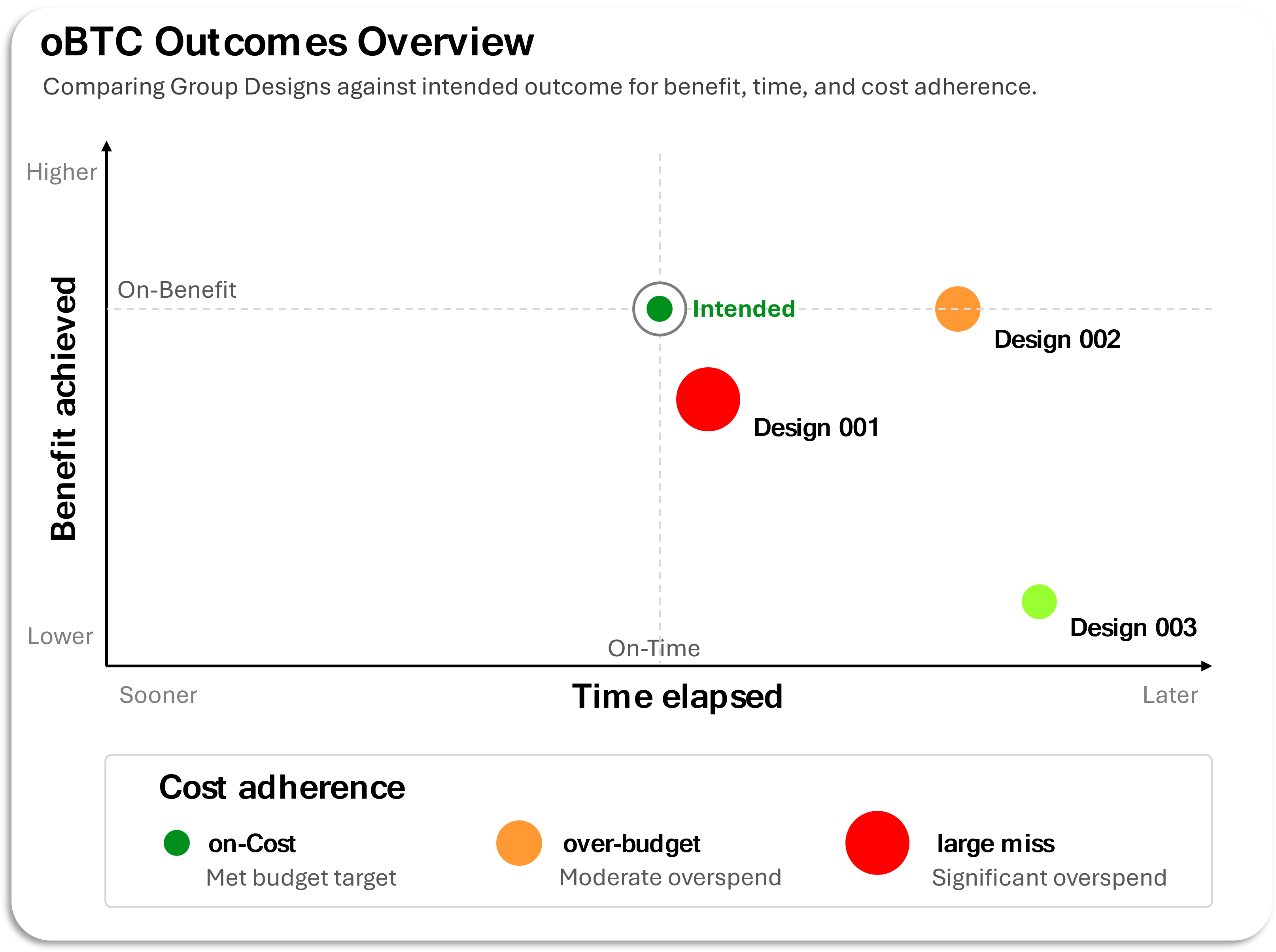
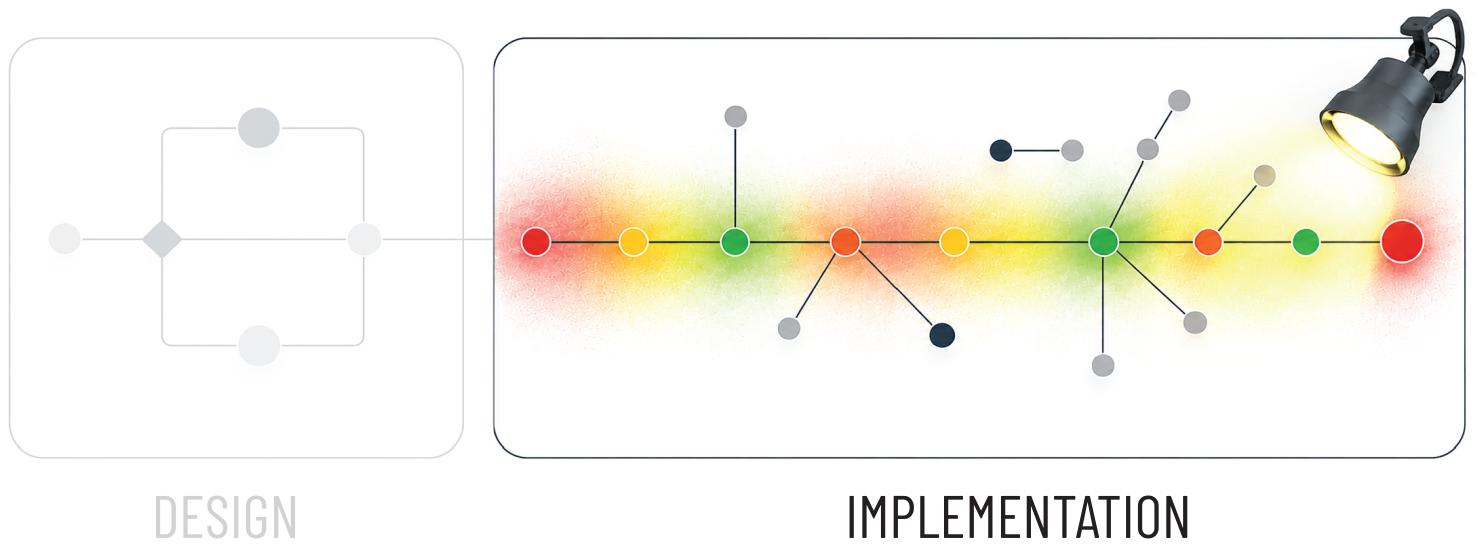
Poor communication, misalignment, resistance to change — the standard explanations describe what went wrong, not where it began.
We founded SchellingPoint to study alignment. What we found: most alignment problems are decision design problems — gaps, hidden assumptions, and unsecured commitments built in before execution starts.
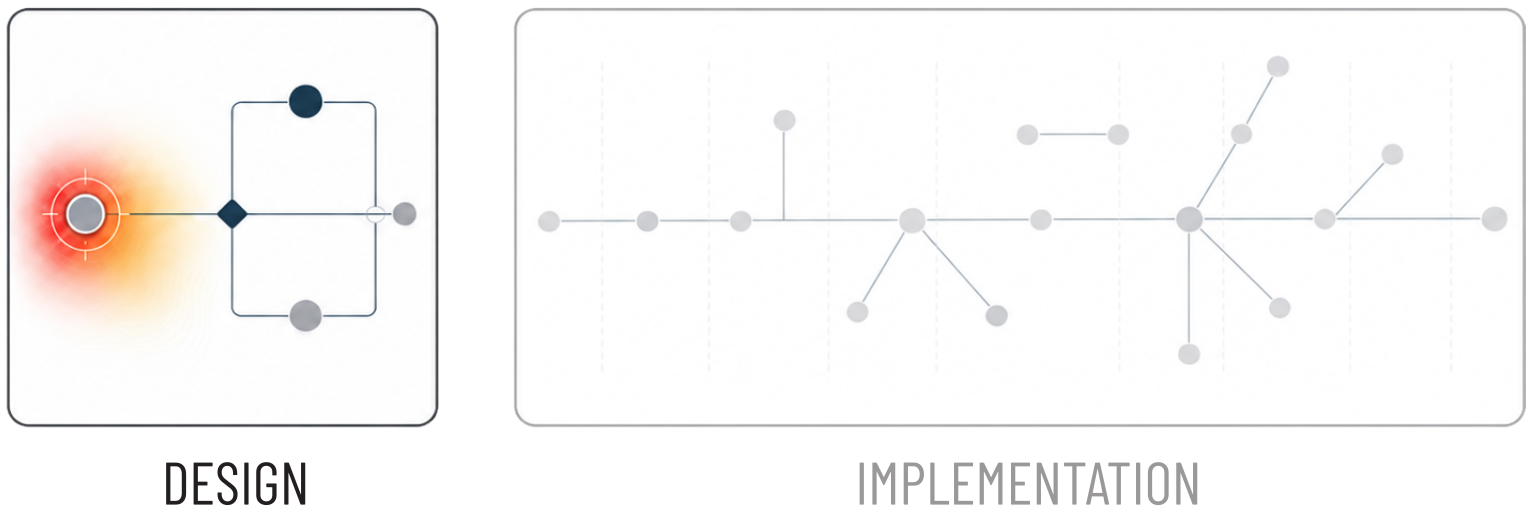
Between "we need to decide" and "we are executing" sits the decision design capability.
Organizations have decades of tools for execution — almost none for the goals and actions they will implement.
Not post-event surveys. We captured group decisions as they happened, at scale — millions of structured observations of what participants believed, where they aligned, and how decisions evolved. The framework, methods, and software are built from that data.


Built on the work of Nobel laureate Prof. Thomas Schelling, Harvard's Chris Argyris, Cornell's Prof. Jay Russo, Argyris' student Gary Lospaluto, and our own Relational Network Analysis.
Two decades in management consulting and business leadership informed the research agenda. Michael leads SchellingPoint’s research program and the development of the Optimal GDM framework.
Tim leads SchellingPoint’s technology development, including the GDM software platform and its AI capabilities. Tim is responsible for implementing Invisible Design - to provide a comfortable interface for users powered by the framework and mathematics.

SchellingPoint is an applied research and experimental development company.
Its research has been converted into a Group Decision Design framework, repeatable methods, workflow-driven software, education, and capability-development services. SchellingPoint can support individual engagements, but the underlying objective is to give organizations an owned and repeatable Group Design capability—not to make each consequential decision dependent on another consulting project.
The research examined Group Decision Design while it was occurring in real situations.
Rather than relying only on retrospective interviews or surveys, SchellingPoint captured participants’ views, reasoning, differences, agreements, and changes in position as groups designed actual goals and actions. Repeated patterns were then used to identify procedural weaknesses, test alternatives, and develop methods that could be applied in subsequent situations.
The purpose was not merely to describe group behavior. It was to improve the process that produces the Group Design.
Optimal GDM builds on established work in coordination, organizational learning, cognitive science, behavioral economics, game theory, and relational network analysis. The academic foundations include work associated with Prof. Thomas Schelling and Prof. Chris Argyris.
SchellingPoint’s contribution is the evolved application: observing how these issues appear in live Group Design, identifying repeatable procedural flaws, developing corrective methods, and operationalizing those methods in a framework and software workflow.
The claim is not that every underlying idea is new. The new contribution is how they have been assembled and applied to Group Decision Design.
You should not accept the conclusions solely because SchellingPoint reports them.
The appropriate tests are data lineage, methodological transparency, review, traceability, and whether the findings can be examined in a real application. SchellingPoint states that its source data is retained unadjusted and encrypted, that its observations have been reviewed by Prof. J. Russo, and that organizations can test the methods on their own consequential situations.
The broader research is not yet formally published. That remains a limitation and should be stated plainly rather than obscured.
That is not the intended model.
Education develops understanding of the concepts and methods. The software carries the repeatable workflow, calculations, analysis, and records. Capability services help an organization establish its own roles, standards, governance, and internal expertise.
Specialist support may remain valuable for unusually complex, sensitive, or consequential situations. But professional Group Design process should not exist only when an outside specialist happens to be present.