A Brilliant New Way to Make Group Decisions Worse
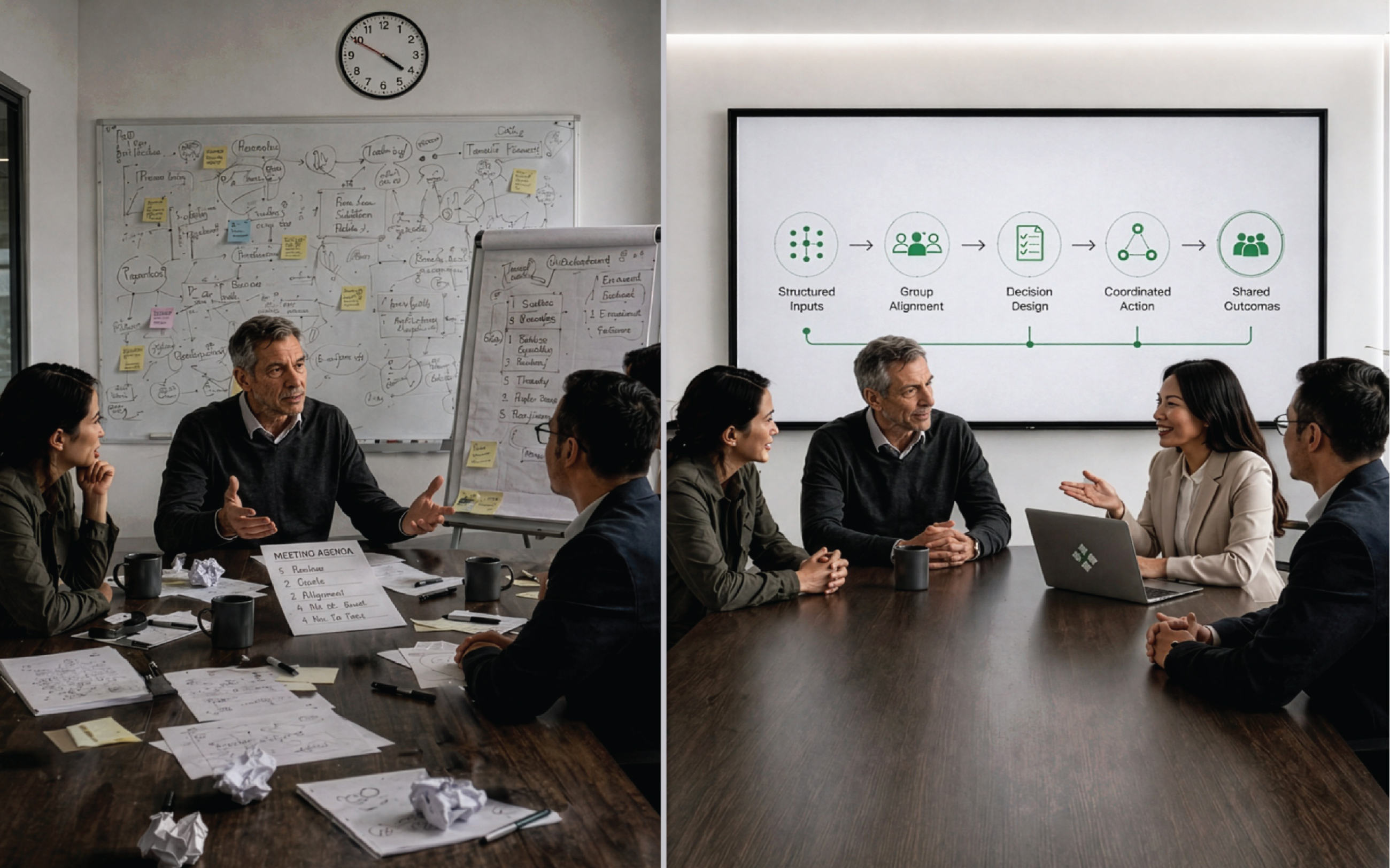
Imagine that companies already possessed a reliable, software-guided method for designing goals and actions. Then imagine someone proposing the way most companies actually do it.
Management innovations usually promise to replace chaos with order. Consider, instead, an innovation that does the reverse.
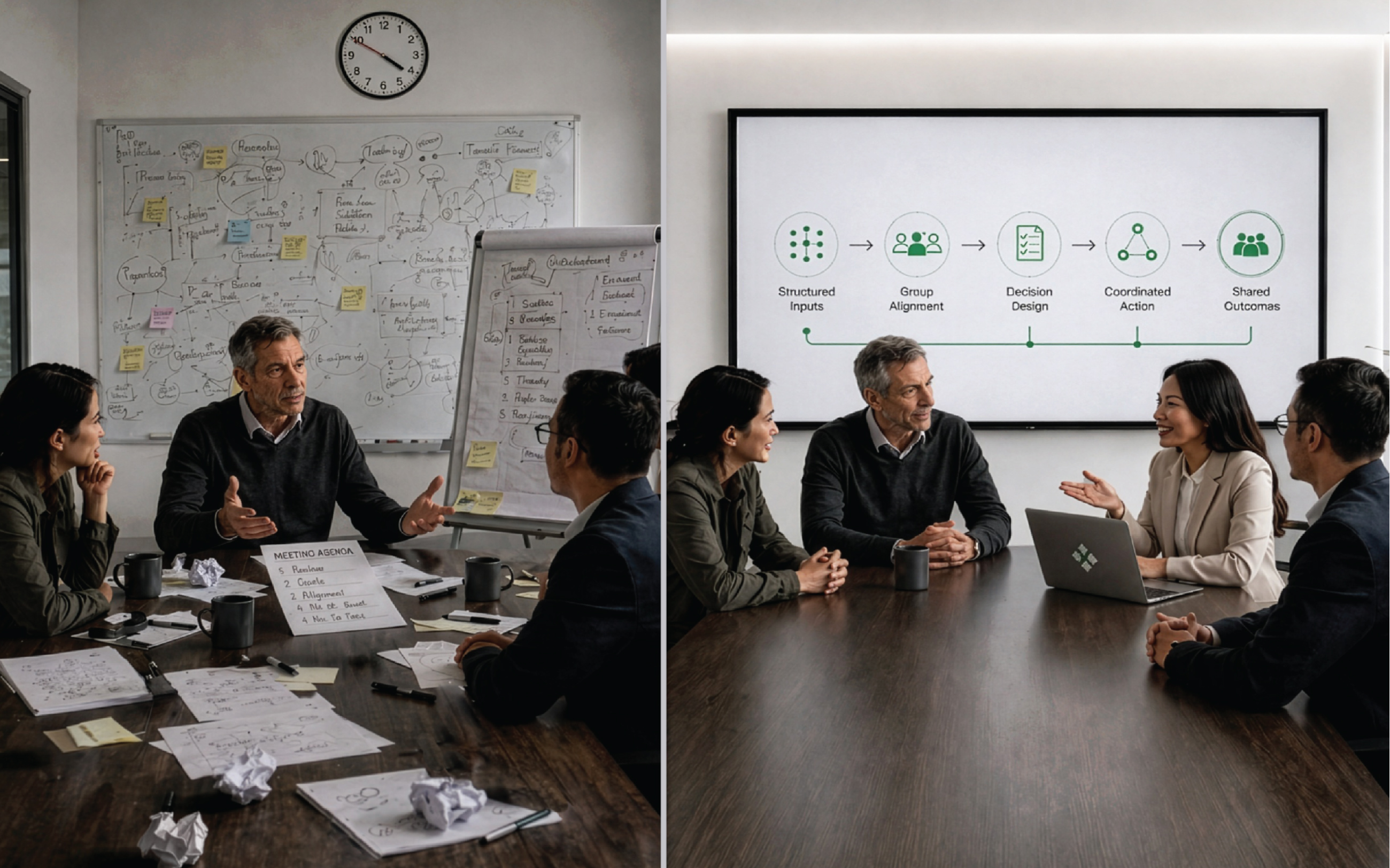
Suppose every organization already had a common process for Group Design.
Whenever a department needed to revise its strategy, respond to a problem, capture an opportunity or coordinate action, the manager would use the same underlying framework. The situation would be mapped. The relevant knowledge of the group would be gathered systematically. Differences would be identified before the meeting rather than discovered accidentally during it. The subjects requiring collective attention would be selected and sequenced. Assumptions, barriers and possible negative consequences would be examined before being handed to implementation as surprises.
The resulting goals and actions would be assessed for Fit, Feasibility and Alignment.
Managers would not need to become professional facilitators. The process would be carried by the software, much as accounting software carries rules that ordinary managers are not expected to reinvent.
Internal organizational-development specialists and external consultants would still be useful. Difficult, sensitive or unusually consequential situations would benefit from their expertise. But professional process would not depend on having a professional in the room.
Then an enterprising person arrives with a new idea.
“We can make this much more flexible,” he says.
There will no longer be a universal process. Instead, each manager can decide how to approach each situation.
The manager will begin by gathering some information that appears relevant. A selection of stakeholders may be interviewed about some aspects of the subject. Their comments, together with available data and perhaps a few slides describing the “current state”, will be used to construct an agenda.
No map will define what needs to be understood. This would be unnecessarily restrictive.
Nor will it be necessary to determine what every participant thinks about every material proposition. It will be enough to know what some stakeholders said about the matters they happened to be asked about.
The manager will then invite the group to a meeting.
The time available will be determined not by the amount of work required, but by the availability of calendars. This provides a useful sense of urgency.
The group will discuss the items on the agenda. Subjects on which people already appear to agree will often receive considerable attention, since agreeable conversations move smoothly and create visible progress.
Disagreements will also be discussed. There will be no prescribed method for resolving them. Participants will exchange views until they reach agreement, become tired, run out of time or defer to the person with the most organizational authority.
This is known as dialogue.
Barriers, doubtful assumptions and possible negative side-effects may be raised. But excessive negativity can damage the energy in the room. Many such matters can therefore be recorded in a parking lot, assigned to implementation teams or treated as problems to be solved later.
Eventually, the group will produce a collection of goals and actions that seems broadly sensible.
There will be no objective way to determine how closely the response fits the situation, whether its constraints have been sufficiently mitigated or whether the people required to implement it are genuinely aligned.
The leader will instead ask an affirmatory question.
“So, are we all agreed that this is what we are going to do?”
Anyone wishing to disagree must now challenge the apparent consensus in front of the leader and the rest of the group, just as the meeting is drawing to a close.
Surprisingly few will do so.
The absence of an objection can then be recorded as alignment.
This new approach will be inexpensive. It will also be familiar, which is often better than being effective.
For the largest, most troubled or politically sensitive situations, the organization may still bring in an internal specialist or hire an external consultant. The specialist will arrive with a process shaped by training, experience and personal preference.
A different specialist may bring a different process.
The organization will retain the output: the presentation, the strategy, the action plan and perhaps a photograph of several walls covered in sticky notes.
The process itself will usually leave with the specialist.
The next manager confronting the next Group Design situation will therefore enjoy the freedom to begin again.
This arrangement has several attractive properties.
It allows every manager to improvise a decision process without first learning whether it works. It enables each department to develop its own terminology, sequence, standards and definition of completion. It concentrates professional support on the small number of situations already recognised as sufficiently serious to require it.
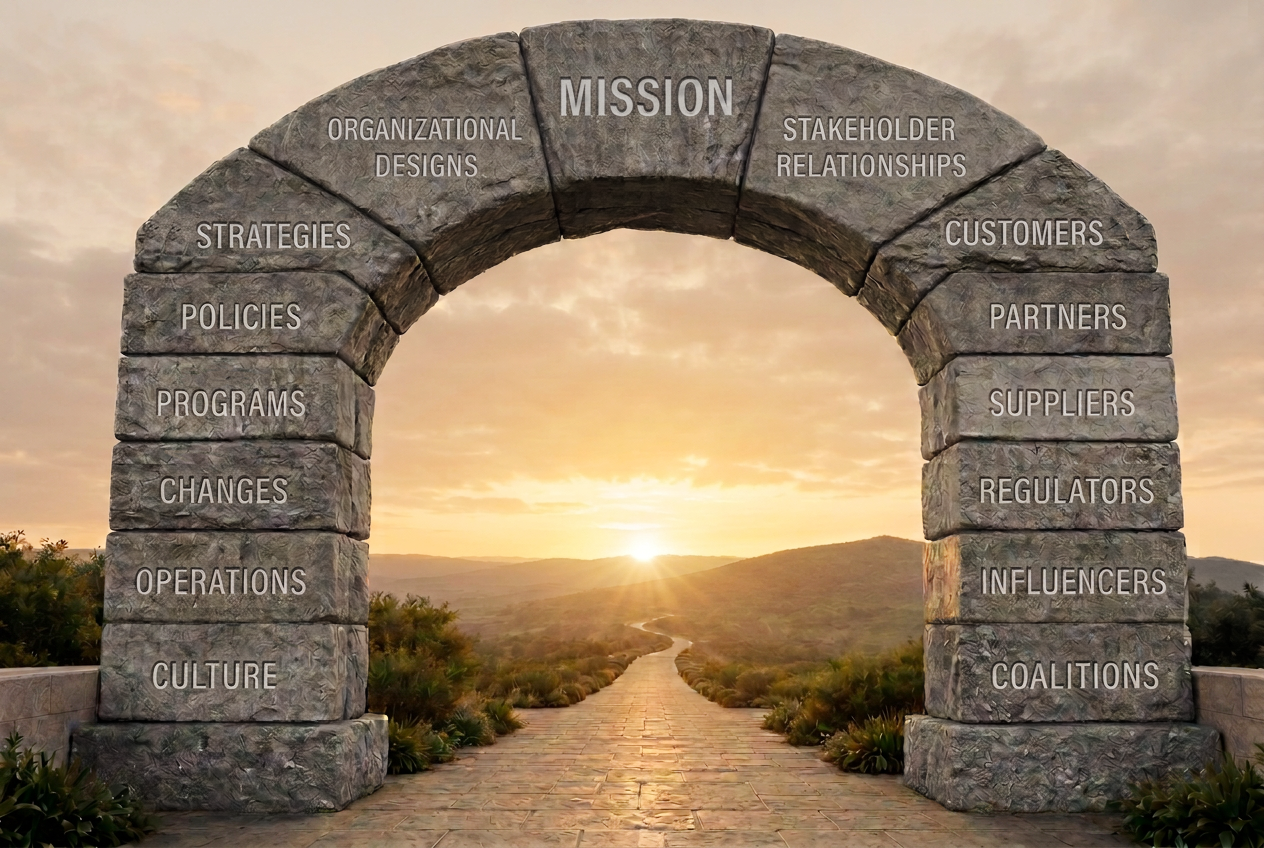
The ordinary situations—the departmental strategies, policy revisions, operating changes, cross-functional problems and emerging opportunities that cumulatively determine organizational performance—can continue to be handled through managerial instinct and scheduled conversation.
This is called empowerment.
Its principal advantage is that almost any result can be defended.
If the response succeeds, the meeting was effective. If it fails, the environment changed, employees resisted, competitors behaved unexpectedly or implementation was poor.
Because the quality of the design was never measured, the design itself need never be blamed.
Professional facilitators are not the problem with this model. Their expertise can greatly improve a difficult Group Design. The problem is an organization in which professional process exists only when such a person is present.
A fire brigade is valuable. That is not an argument against installing sprinklers.
No organization already using a consistent, inspectable and measurable Group Design process would willingly replace it with this arrangement.
It would not exchange an owned capability for a succession of improvised meetings. It would not replace systematic access to collective knowledge with selective interviews. It would not replace measured alignment with public non-objection. It would not make the quality of a critical organizational process depend on which manager or specialist happened to be involved.
Yet this is approximately how most Group Design is conducted today.
Not because organizations consciously selected it.
Because it was already there.
The most durable management systems are often those nobody remembers choosing.
Would you buy your current Group Design process today?