Professionals designing joint ventures and alliances where two organizations must align without either holding authority.
An alliance is a Group Design decision between organizations in which neither party holds the authority to end the argument.
Everything therefore depends on what each side is willing to say early - and both sides are incentivised to leave the difficult expectations vague in order to get the deal signed.
Optimal GDM makes those expectations explicit without putting the partnership at risk, internally first and then jointly, so the agreement rests on reconciled assumptions rather than optimistic ones.
We use the SchellingPoint approach for relationship optimization.
Directors responsible for governance oversight, strategic approval, and ensuring organizational decisions meet fiduciary standards.
Boards are asked to approve responses they did not design, presented by people whose job it is to make them sound ready.
What arrives is a recommendation. What is rarely visible is the reasoning underneath it - which assumptions were tested, which concerns were raised and set aside, and how much of the room genuinely agrees.
Optimal GDM makes that visible before approval, and leaves a defensible record of it afterwards - so boards can tell an implementation-ready decision from a paper tiger.
The Chairman said it was the best strategy he had seen in over a decade.
Professionals responsible for driving adoption and implementation of organizational transformations, ensuring decisions survive handoffs and reality.
The change management field has its frameworks - Lewin, Kotter, Bridges, ADKAR, McKinsey 7-S, et al. What hasn’t yet crossed into it is the Fundamental Theory of Change from cognitive psychology.
A five-element model that explains, at an order of magnitude more granular, what is driving each individual’s support or rejection of any change activity - enabling change managers to bring pinpoint precision for greater impact.
SchellingPoint is part of our next-generation Change Management capability.
Executive and team coaches working with leadership groups whose stated disagreements mask unsurfaced reasoning.
Leadership teams rarely present their real disagreement. They present positions, leaving the coach to infer what sits beneath them from behaviour in the room.
The three reasons a group is not likeminded - different data, different dictionary, different drivers - are diagnosable rather than intuitable.
Optimal GDM gives coaches that diagnosis at the level of individual opinions, so the work goes straight to what is actually dividing the team.
When my client has a team-related issue, SchellingPoint is my first thought to solve it.
External advisors who guide clients through strategic decisions, often serving as Decision Guides who steward the process from signal to response.
Consultants bring knowledge, nuance, and wisdom their clients don’t have - and the moments where that expertise changes a client’s direction are what the work is for.
Everything else is overhead: the scoping, the stakeholder work, the synthesis and documentation.
Optimal GDM handles that overhead and — crucially — ensures the group decision design process their expertise flows through is worthy of what it carries.
We found that projects are tangibly less successful where we didn't use SchellingPoint.
Senior leaders who participate in, commission and lead the Group Design decisions that set organizational direction.
Executives participate in, commission and lead Group Design decisions - putting the organization’s most expensive time and effort on the line. It needs to have been worthwhile.
Executives should at least know the concepts and methods of Optimal GDM.
While their peers talk win-win platitudes, our clients impress with their use of situational system dynamics and group game theory.
It is not the strategy I believed was needed when we started. But it is the strategy we need. I will lead its implementation.
Professionals who manage group dynamics and dialogue processes, converting diverse stakeholder perspectives into actionable agreements.
What draws facilitators to their work is what happens in the room - people heard, conflict resolved, groups that leave highly aligned and energized to act. What consumes too much of their time is everything outside it.
Scoping the topic, gathering opinions, designing agendas, synthesising findings, documenting outputs, and over twenty other tasks.
Optimal GDM handles that burden — with AI, at the highest quality, with minimal effort - so facilitators can spend more time where they do their best work.
For setting up and running a client project, the time-saving is incredible.
Founding teams designing the direction of a new venture, where co-founder misalignment is rarely surfaced until it is expensive.
Founders make the highest-consequence Group Design decisions of any role, with the least structure around them, at exactly the point when slowing down feels least affordable.
Co-founder breakdowns are rarely a disagreement about direction. They are unexamined differences in what success looks like, what the real constraints are, and who decides what.
Optimal GDM surfaces those differences while they are still cheap to reconcile.
The SchellingPoint work to clarify exactly how we were going to use our funding was instrumental in our strategic acquisition four years later.
Venture, private equity and grant-making committees deciding where capital is placed and on what evidence.
An investment committee is a group designing a shared response under uncertainty, then recording the result as a number.
The diligence is rigorous. The conversation that turns it into a decision usually is not - concerns are raised once, deferred, and never reconciled, and the committee cannot tell whether it agreed or simply stopped arguing.
Optimal GDM measures that difference, and leaves an auditable record of the reasoning behind every commitment.
SchellingPoint gives me greater confidence in the quality of the proposals we evaluate for inclusion in the portfolio.
N/A
Leaders can be anyone in any role, independent of title. In the context of decision-making, leaders are those who, when they experience a signal warranting a response, find a way to.
Leaders don't admire problems and opportunities, they respond to them - often when others could, should, or want to, but don't.
Group Design is how leaders actively lead.
This problem had gone nowhere for three years and was hurting our state and our industry. SchellingPoint's approach turned that around in three months. Three years later, we've changed the sector.
Managers accountable for team performance who routinely make Informed-Design and Group Design decisions affecting their group's goals, processes, policies, and people.
Many line managers lead more Group Design decisions than almost anyone in the organization - functional strategies, policies, improvements, changes, operating problem solutions, relationship designs.
Yet the responsibility is treated as just another thing that comes with being a manager. Now, Group Design exists as a discipline they can use.
Optimal GDM provides a dictionary and way of thinking they can share with their personnel and software so they can apply it without a learning curve.
We have consultants who come in and out with their methodologies and black boxes, and none match this.
Corporate development and post-merger integration leads joining two organizations that never reconciled their success criteria.
Two organizations that each made sense internally are combined into one that has to make sense jointly - and the assumptions each side relied on are never reconciled, only overwritten by whichever side won.
Integration then discovers, function by function, that the synergy case rested on beliefs the other side never held.
Optimal GDM reconciles those assumptions during diligence and integration design, while the cost of finding a difference is still a conversation rather than a write-down.
Looking back two years, the SchellingPoint activity, to clarify among everyone what was needed for a successful integration, was one of the smallest merger budget items. And it was probably the most influential on our success.
Government officials and organizational leaders who design policies affecting multiple stakeholders with competing interests and constraints.
Policy development is as laborious as it is incomplete - too dependent on who participates, too slow to converge, and rarely confident it has captured what communities actually think.
Replacing the tired traditional Constructive GDM techniques, Optimal GDM provides far greater accuracy and completeness in understanding community interests, views, and concerns, then pinpoints the crucial dialogues to converge on the most appropriate policy — with less effort, and more satisfied policy makers and stakeholders on all sides.
The SchellingPoint process cut through the politics like a hot knife through butter.
Act in an advisory and consulting role using DMAIC/DMADV/FMEA-AP and other techniques to identify operational improvement opportunities.
Process Improvement Experts operate from within and outside organizations.
They primarly act in an advisory and consulting role using DMAIC/DMADV/FMEA-AP and other techniques to identify operational improvement opportunities.
They use Optimal GDM in multi-stakeholder improvement projects, starting as the Define step. It's use creates stronger, more endorsed charters from decision-makers.
They see an increase the value of improvement proposals. A decrease in the number of rejected and watered-down proposals. They implement improvements with less turmoil and closer on-benefit, time, cost performance.
We achieved our three-year transformation objectives by the end of the first year.
Professionals who set product direction and priorities across permanently non-likeminded functions.
Product managers set direction for a group that is non-likeminded by design - engineering, design, sales, support, finance, each holding a legitimate and different view of what matters most.
The roadmap gets decided anyway, usually by whoever argues best or escalates fastest. The differences that were never surfaced return later as delivery friction and blame.
Optimal GDM converts those competing views into an explicit, aligned design - so the roadmap holds when it meets the organization.
The SchellingPoint process enabled us to create a business case for our next-generation product with insights regular Voice of the Customer and Market Research methods couldn't provide. Including telling us we were wrong on a few things.
Professionals accountable for delivering defined outcomes within constraints, translating strategic decisions into executed results.
Transformation, program, and project managers are some of the first professionals being let down by the faulty concepts and methods of Constructive GDM they are required to use.
Optimal GDM either delivers an optimal charter from the commissioning group, or gives project managers the tools to build it themselves, faster and with far less effort than the recovery work that’s become routine.
And when projects go badly, where current recovery methods rarely find the actual root cause, Optimal GDM does.
If you are not using SchellingPoint in creating your program/project charters, you don't have a world-class PMO.
Professionals who manage ongoing partnerships, alliances, joint ventures, and customer/supplier relationships requiring continuous alignment and coordination.
The stronger the desire to form and maintain a valuable relationship, the more the difficult conversations get avoided — leaving agreements incomplete at formation and reviews performative throughout.
Optimal GDM gives relationship managers the tools to have complete conversations at every stage of the relationship lifecycle, without putting the relationship itself at risk.
This was the first time I experienced genuine partnering behavior from a supplier.
Leaders and teams responsible for designing organizational direction, including business strategy, product strategy, and market positioning.
Strategy development brings exceptional analytical rigor — competitive landscapes, current-state assessments, market data, KPIs.
What that analysis passes through - a Group Design process conducting using Constructive GDM concepts and methods, consistently churns out false positives.
Optimal GDM channels the same rigor into strategies with higher fit, greater feasibility, and stronger alignment.
My leadership team has never created so much output with so much quality in so little time before.
The buy-side mirror of account management, defining requirements and selection criteria that stakeholders never fully agreed.
Procurement is asked to run a rigorous selection against requirements the stakeholders never actually agreed.
Each function specifies what it needs in isolation, the trade-offs between them are settled by whoever holds the pen, and the disagreement resurfaces after signature - as scope disputes, as poor adoption, or as a supplier blamed for delivering exactly what was asked for.
Optimal GDM provides the buying group with the best possible internal requirements specification before the market is approached, for a more efficient approval process.
Any professional involved in collaborative decision-making where diverse opinions must be converted into coordinated action across boundaries.
Group Design is not confined to a job title. Anyone who has to turn a room full of different views into one coordinated response is doing it, whether or not they call it that.
The situations differ enormously. The structural problem does not - opinions that were never surfaced, assumptions that were never reconciled, and a decision that looks stronger than it is.
Optimal GDM applies to all of them.
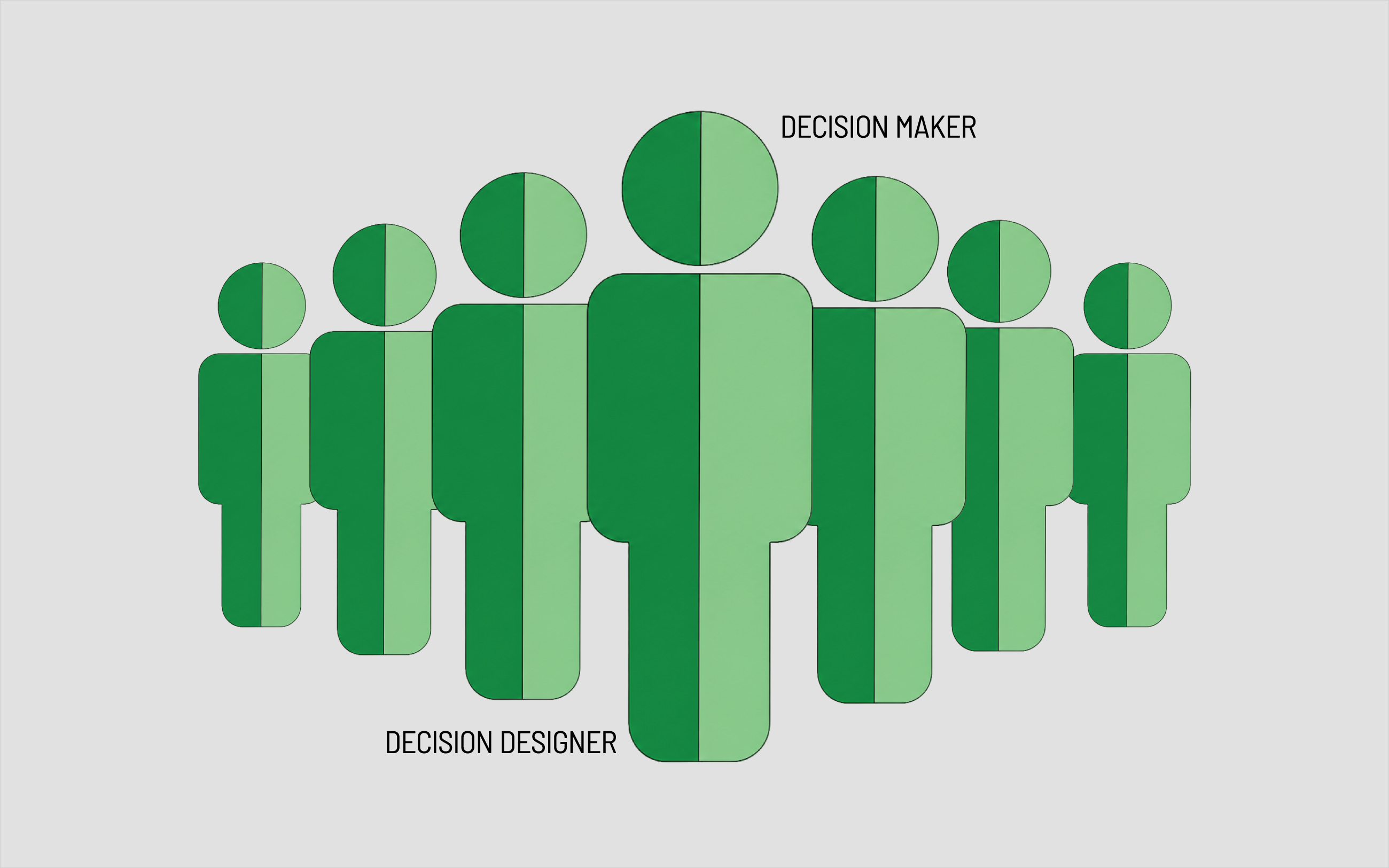
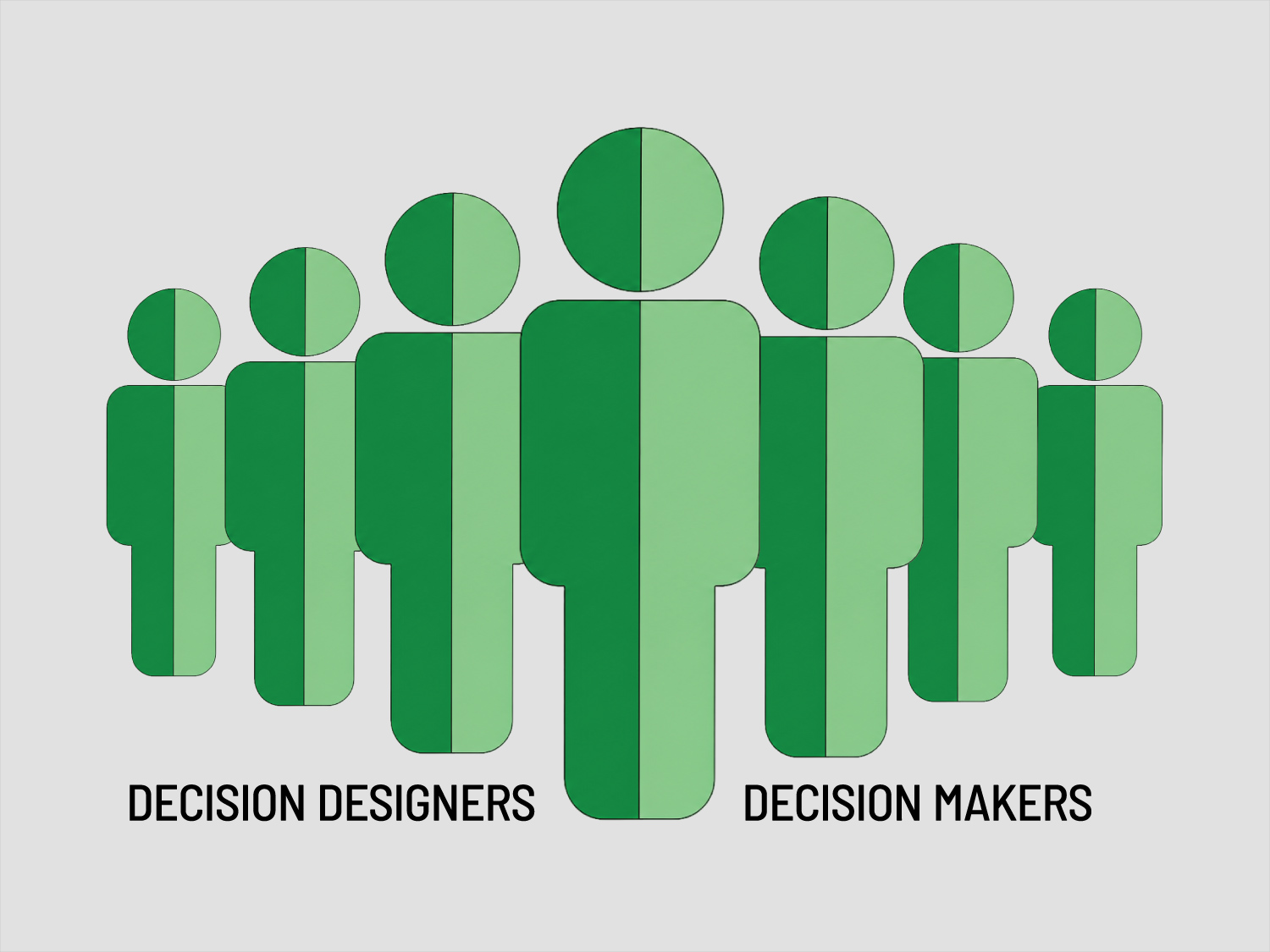
Leaders and managers can now receive the Decision Designer capability that goes with the responsibility.