Research Overview

Real-time Group Decision Design data.

Group Design DNA Revealed

A unique research base.

  • > 600+ groups
  • > Involving 1 to 300+ organizations
  • > Small teams to global communities
  • > Public, private enterprises, governments, academia, non-profits
  • > Strategic to tactical topics
  • > 2 to several thousand participants
  • > 110,000+ total participants
  • > 30,000+ total leaders
  • > From initial opinions to agreed goals and actions
  • > Gathered real-time
  • > 30+ characteristics per situation
  • 12,000,000+ DATA POINTS

Identical snowflakes.

Every situation was identical in that a group set out to identify and agree on goals and actions in response to a signal.

At the same time, every situation was also unique.
We use over two dozen characteristics to differentiate each situation, such as these twelve:

Hover over a facet type for its explanation.

The trigger

Signal Type

What triggered the need to form a response.

Opportunity

A discretionary choice to create significant new value.

Improvement

Optionally improving something to support an objective.

Problem

An unavoidable problem that is or will cause damage.
The trigger

Core Purpose

The overall objective for the topic.

Diagnostic

Assessing to affirm performance or surface hidden problems.

Generative

Creating a new future - improvements and opportunities.

Restorative

Bringing a situation from struggling to viable.
The trigger

Reaction Time

When the design's objectives need to materialize.

Accelerated

Designing goals and actions received a high priority.

TIMELY

The time from signal to starting to respond was acceptable.

Delayed

Starting to respond to the situation took longer than desired.
The trigger

Impact Timeframe

When the goal's attainment needs to impact the topic.

Horizon

Action may start sooner but the impact is not needed until later.

Soon

There is no rush, but impact sooner is better than later.

Yesterday

The group feels pressured to create impact ASAP.
The topic and context

Organizational Scope

The number of separate organizations involved.

Within

Group members are within one legal entity.

Between

Group members are from two legal entities.

Across

Group members are from many legal entities.
The topic and context

Geographical Scope

The geographical nature of the topic.

Local

Group members are within one community.

Regional

Group members are from different communities.

Global

Group members span much of the globe.
The topic and context

Topic Maturity

What there was to know about the topic at the time.

Mature

The topic is established and understood. Nuance and wisdom exist.

Familiar

The topic is practiced. There is reliable information and knowledge.

Emerging

The topic is new, early, or developing. Form and function are emerging.
The topic and context

System Stability

The level of change and uncertainty in the system of the topic.

Stable

Few things are likely to change before the results are required.

Uncertainty

Multiple factors are unknown and might take different directions.

Dynamic

The situation is 'fluid' with consequential changes expected.
The group

Group Familiarity

The group's knowledge of each other.

Experienced

The group mostly know each other well.

Familiar

Many to all group members are familiar with each other.

New

Group members are all or mostly unfamiliar with each other.
The group

Group Mood

The initial mood within the group.

Warm

The group is mostly friendly and positive toward each other.

Tepid

The group is mostly cordial and open-minded toward each other.

Cold

There are tensions and strains in some members' relationships.
The group

Power Location

Where the decision-making power resided within the group.

Centralized

One individual has the ultimate say and power of veto.

Shared

Two individuals are responsible for the response.

Distributed

Each group member can decide how they act.
The group

Impact Proximity

The proximity of the goals to the group members.

Remote

The primary decision designers aren't directly impacted by the design.

Connected

The goals and actions will mostly impact their work.

Personal

The goals and actions matter directly to most of the group members.
Here are three examples of how each group and their shared topic differ using those twelve characteristics:
No KNOWN OR INFERRED NEGATIVE FORCES

Refreshing the 5-Year Enterprise Vision

A Fortune 100 CEO, before an enterprise-wide transformation program, engaged his leadership team to verify they shared one vision for the organization. Its situation profile:
Signal Type
Improvement
Core Purpose
Diagnostic
Reaction Time
Accelerated
Impact Timeframe
Horizon
Organizational Scope
Within
Geographical Scope
Local
Topic Maturity
Mature
System Stability
Uncertainty
Group Familiarity
Experienced
Group Mood
Warm
Power Location
Centralized
Impact Proximity
Connected
SOME KNOWN OR INFERRED NEGATIVE FORCES

Annual Goal Setting and Priorities

A private-equity-acquired retailer's new CEO brought new and pre-acquisition leaders together to take stock and set core objectives for the next 12 to 18 months. Its situation profile:
Signal Type
Improvement
Core Purpose
Generative
Reaction Time
Timely
Impact Timeframe
Soon
Organizational Scope
Within
Geographical Scope
Local
Topic Maturity
Familiar
System Stability
Uncertainty
Group Familiarity
Familiar
Group Mood
Tepid
Power Location
Centralized
Impact Proximity
Personal
SEVERAL KNOWN AND INFERRED NEGATIVE FORCES

Designing a Sustainable Health Information Exchange

A US state's Health Information Exchange, facing an accelerated end of its grant funding, brought stakeholders with competing interests together to design a strategy for financial sustainability. Its situation profile:
Signal Type
Problem
Core Purpose
Restorative
Reaction Time
Delayed
Impact Timeframe
Yesterday
Organizational Scope
Across
Geographical Scope
Regional
Topic Maturity
Emerging
System Stability
Dynamic
Group Familiarity
Familiar
Group Mood
Tepid
Power Location
Distributed
Impact Proximity
Connected
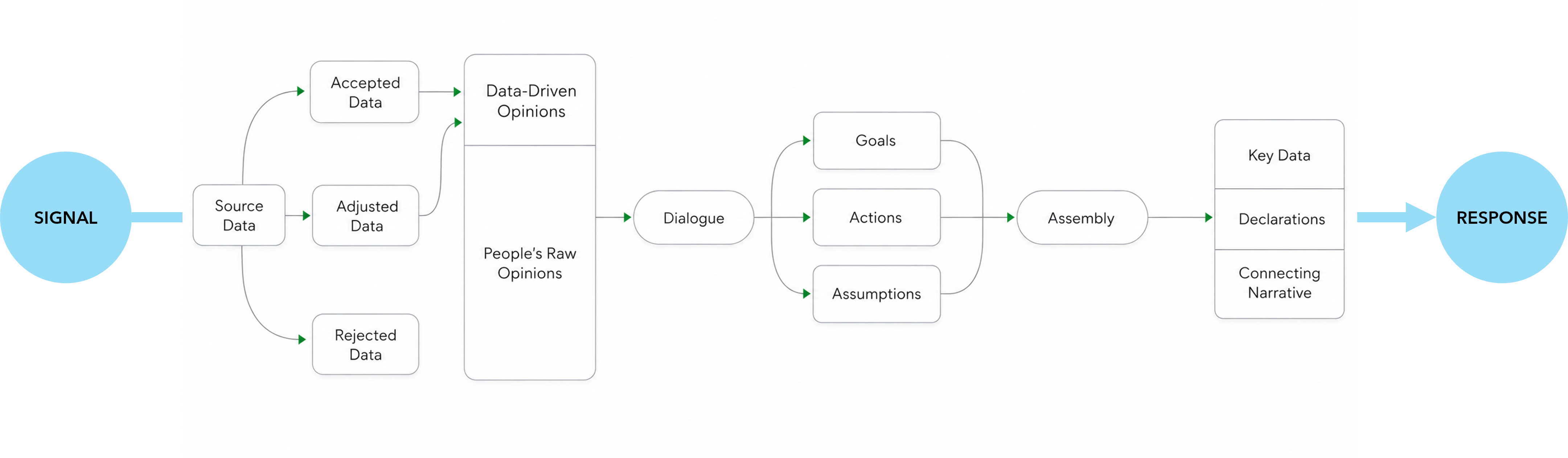
Each Group Design is a Signal to Response journey.
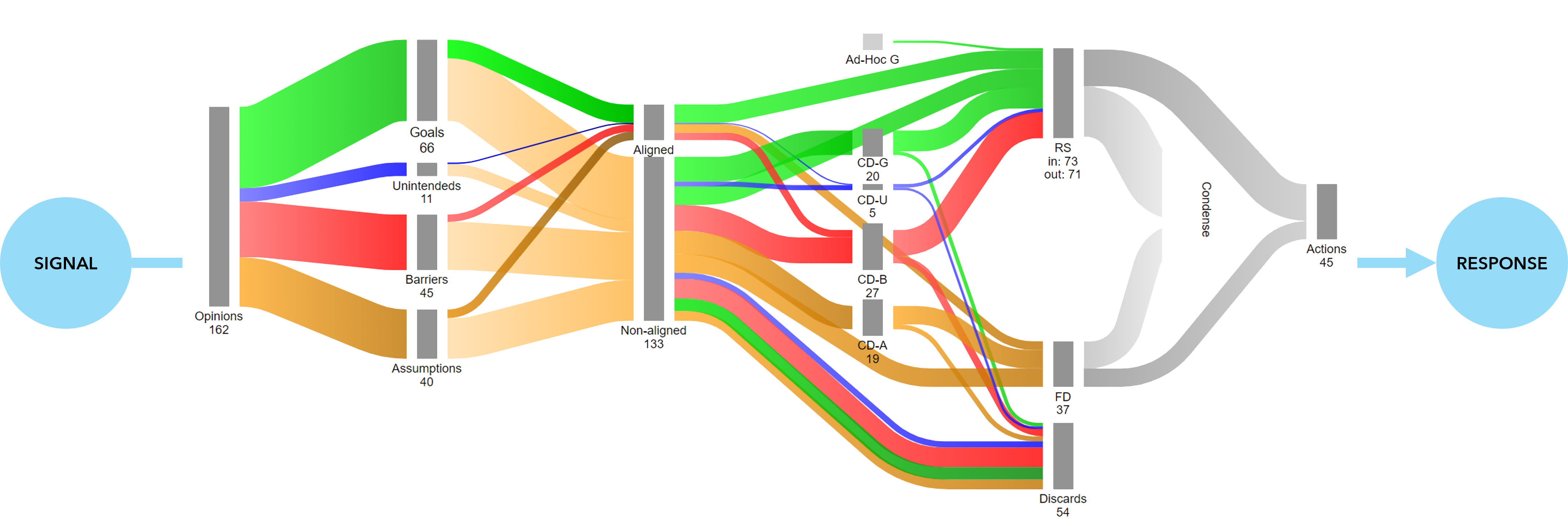
The graphic below shows the conversion of data and discussion into plans of actions.

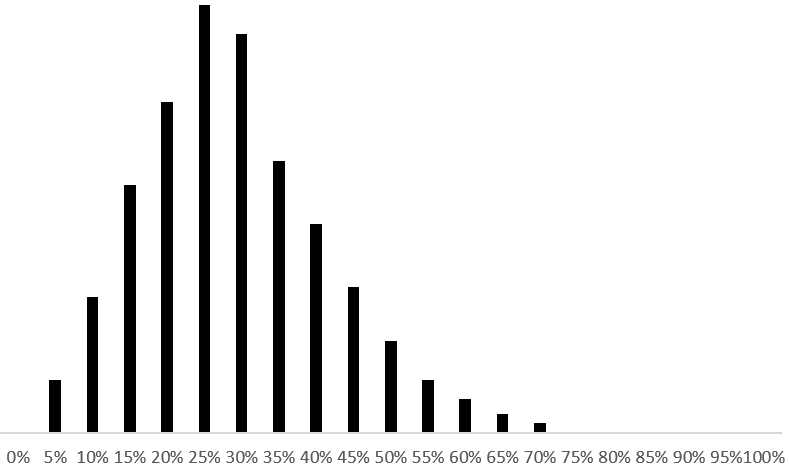
Insight - Facts and figures inform only 5% to 25% of a group's chosen goals and actions.

Data -> Opinions

Opinions -> Declarations

Declarations -> Decisions

Source data, "The market is growing at 3%", becomes an opinion "The market is growing at 3%" or some other view of it. Opinions without direct evidence constitute the majority of decision raw material.
Groups use dialogue to convert their opinions into goals, assumptions, and actions. Each is a form of declaration."It is...", "They are...", "We will..."
A strategy, policy, or future-defining plan is the assembly of the declarations bound within connective narrative. "Having looked at the opportunity..."
Each group's opinions take a unique journey.
- The chart illustrates the flow opinions can take.
- The columns depict the volume and type of opinions, their state, and the rate at which they convert into decision design output.
- The numbered sections explain the change in the Collective Intelligence within which the optimal design is latent.

Insight: For each group and situation, there is an ideal flow, and an actual flow driven by the Group Design concepts and methods being used.  
1
2
3
4
5
1

Collective Intelligence

The total cognitive capacity of the group.
On the diagram: Opinions (162)
2

Shared Intelligence

The portion of a group's intelligence where they are likeminded.
On the diagram: Aligned
3

Dispersed Intelligence

The portion of a group's intelligence where they are non-likeminded.
On the diagram: Non-aligned (133)
4

Decision Intelligence

The portion of the collective intelligence converted into assumptions, goals, and actions.
On the diagram: RS, FD, Condense, and Actions
5

Residual Intelligence

The portion of the group's intelligence not incorporated into the decision, that may impact its implementation.
On the diagram: Discards

Inside Group Designs.

The group decision making big data is helping us better understand the Group Design activity.

Three examples:

Answer questions...

Test hypotheses...

Gain new insight...

Question

Hypothesis

Inquiry

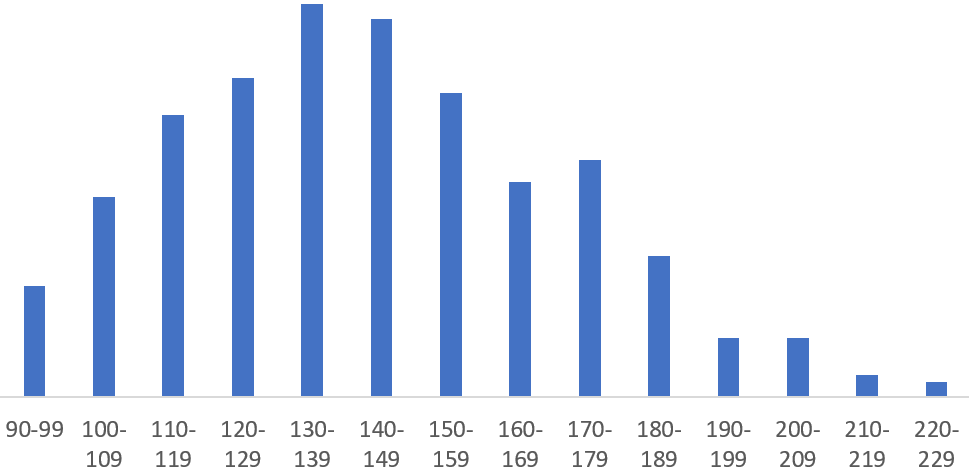
"If opinions are the primary decision raw material, how many do groups have?"
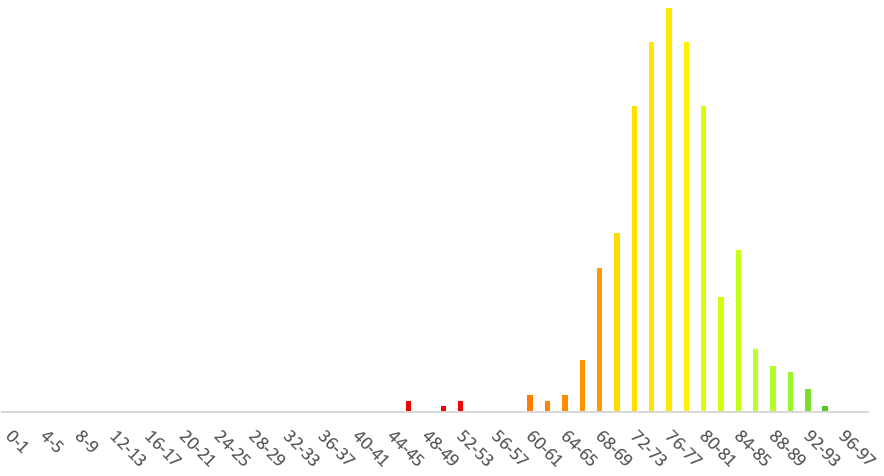
"Groups are either aligned or not aligned."
"Groups prematurely reject multiple ideas they agree with due to feasibility concerns."

Data

Data

Data

Groups average 134 unique relevant opinions on a shared topic, ranging from 110 to 230.
No group has ever been fully likeminded. On a scale of 0 to 100, every group measured has been between 46 and 92. The mean is 76.
An example: Of 27 suggested strategy actions, 20 were rejected by the majority for "It can't be done" reasons.
Placeholder image
Placeholder image

New Knowledge

New Knowledge

New Knowledge

Ad hoc goal and action design meetings might cover 30 to 50 of a group's opinions, the other 2/3 left unspoken.

Many later compromise implemenation of the 'agreed' goals and actions.

Response

Design a way to maximize the likelihood all participants will share all relevant opinions.
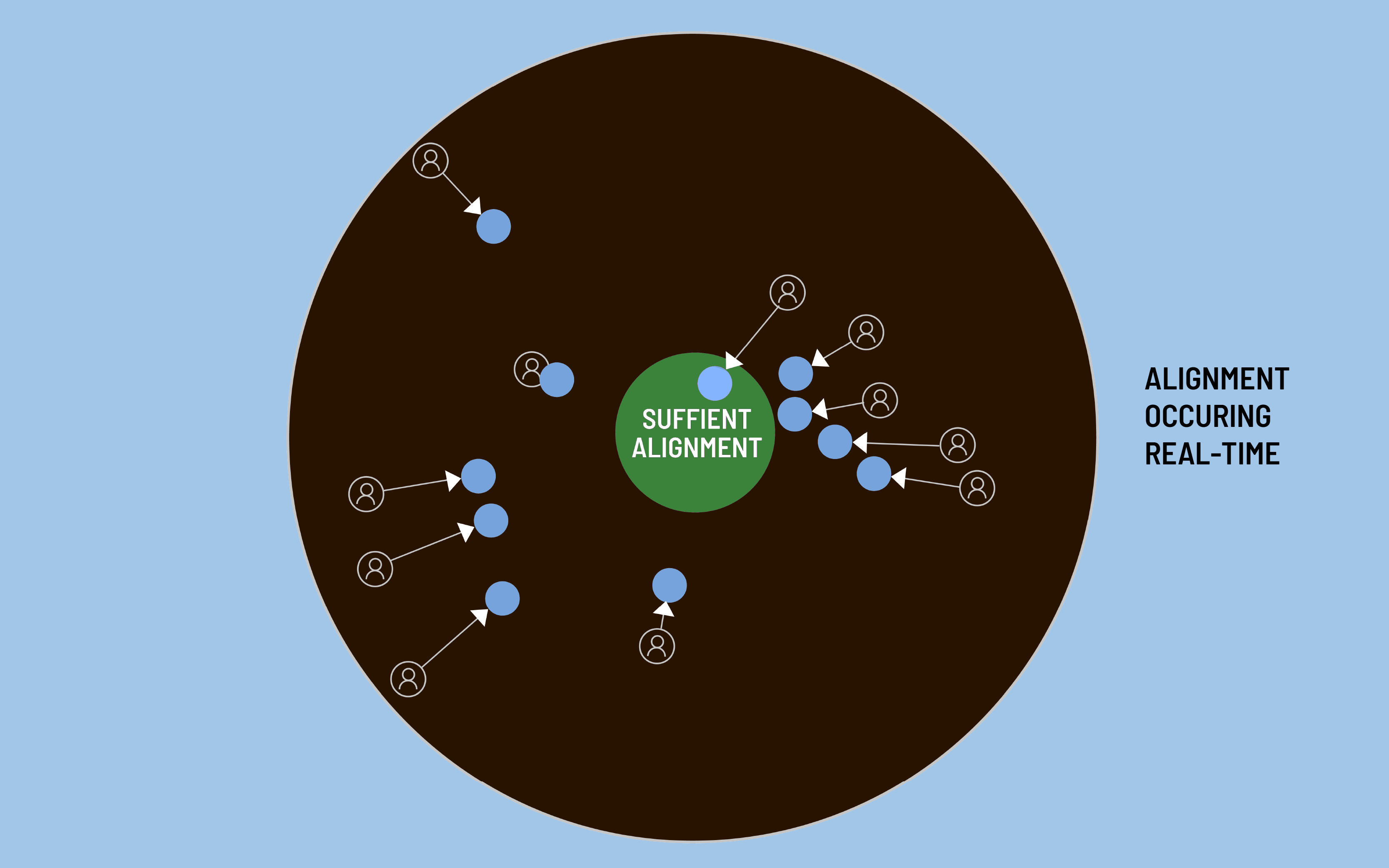
The aspiration to 'Get aligned' is impractical. Claims that 'We are aligned' or 'We will get aligned.' are false.

Teams have different Degrees of Alignment on each different topic.

Response

Objectively measure a group's initial Likemindedness and the Sufficient Alignment value.
In almost all cases, groups prematurely discarded multiple ideas a majority agreed with but rejected due to feasibility concerns.

We label the behavior Feasibility-Bias.

Response

Separate goal and action necessity from feasibility. Identify Feasibility-Bias when it occurs.
For more findings, see the Design Content Insights and Design Process Insights pages.
FAQ
Frequently asked questions
To what extent could people's views, opinions, and reasoning be skewed due to personal safety concerns?
How is the data captured?
Is any group, situation, or critical perspective under-represented or missing from the research data?
How is SchellingPoint's research different from academic decision-making research?
What does 'real-time' data collection mean?
What is a declaration, and why does it matter?
What does the intelligence model explain?
What is the scale of the research?