
Change management begins at implementation. Its frameworks — Lewin, Kotter, Bridges, ADKAR, McKinsey 7-S — are built around guiding organisations and individuals through transition: creating awareness, building understanding, generating commitment, and sustaining change over time. The discipline is sophisticated, and the practitioners who apply it are often working at the leading edge of organisational complexity.
But every change program begins with a decision. A goal set by a group, using whatever process that group happens to use for collective decision-making. In most organisations, that process is Constructive GDM — the inherited, improvised approach that groups have used for decades because no one designed anything better. No structure. No verification. No mechanism for ensuring the goal actually fits the organisation, that constraints are known, or that the alignment in the room is genuine rather than social compliance.
Change management inherits this. Its frameworks begin at “the decision has been made.” They assume it was sound. When it wasn’t — when the goal was incomplete, the feasibility wasn’t verified, or the stakeholders who nodded along hadn’t genuinely signed on — the change manager is left managing a problem that was created upstream and cannot be fixed downstream.
Change managers are skilled at identifying and addressing resistance. What the standard frameworks can’t distinguish is resistance that is inaccurate — where people could be moved through better communication or engagement — from resistance that is accurate — where people are recognising that the goal doesn’t fit, the plan isn’t feasible, or their context wasn’t genuinely considered. Driving adoption of the latter is expensive, exhausting, and frequently unsuccessful.
The rework pattern is familiar: sustained resistance, escalating intervention, revised communication plans, and eventually either a programme redesign or a forced implementation that produces compliance without commitment. The root cause is almost never the change management execution. It’s the decision design upstream.
The change management field has its frameworks — Lewin, Kotter, Bridges, ADKAR, McKinsey 7-S. What hasn’t yet crossed into it is the Fundamental Theory of Change from cognitive psychology: a research base that explains, at an order of magnitude more granular level, what is driving each individual’s support or rejection of any change activity — enabling change managers to determine actions and communications with pinpoint precision, and far greater impact. Without it, even the most disciplined change programs are working from a coarser map than the problem requires.
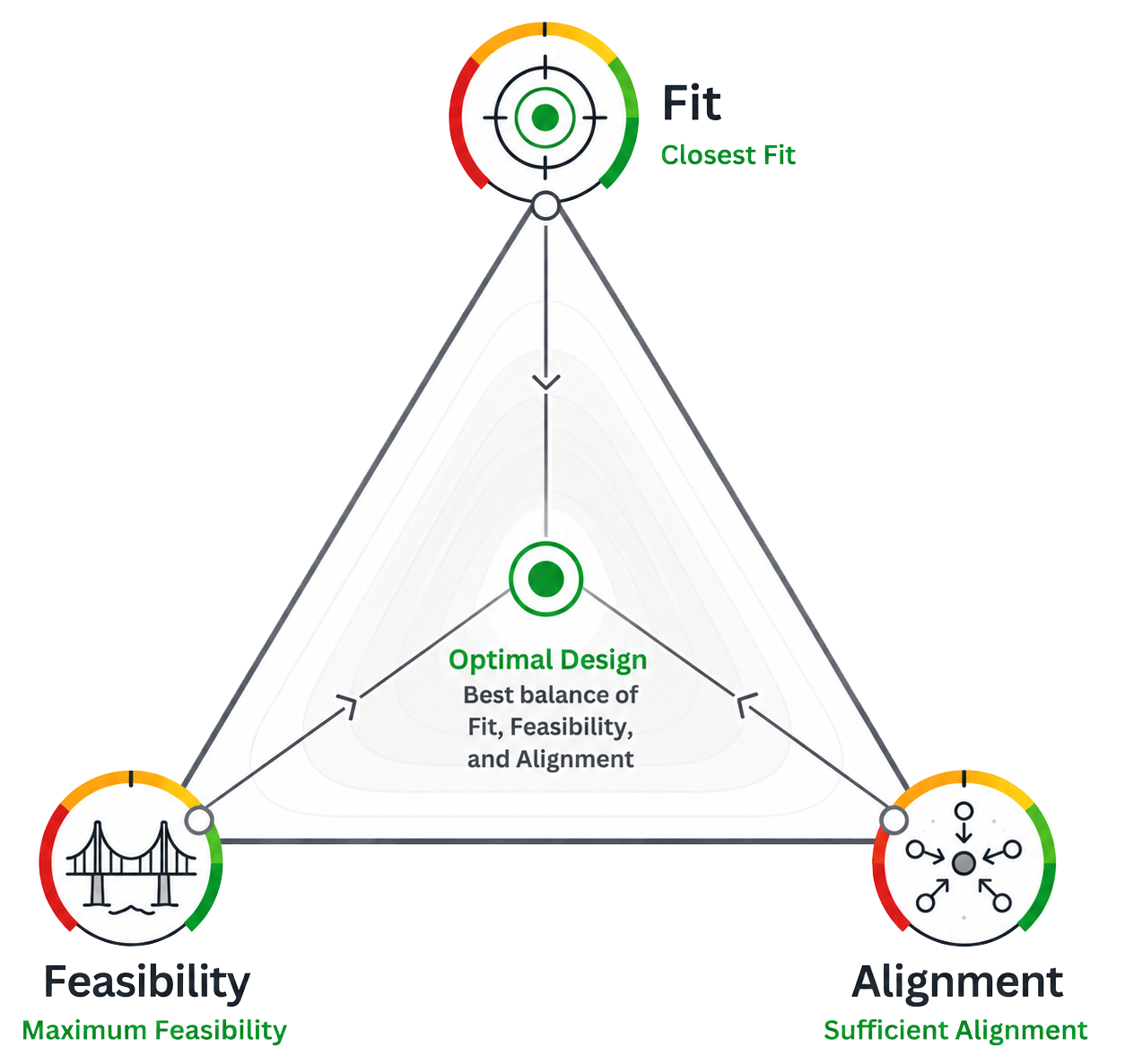
Optimal GDM is the research-based replacement for decades of Constructive GDM. It doesn’t replace change management expertise, stakeholder engagement capability, or the implementation frameworks that define the field. It replaces the group decision design process that sits upstream of every change program — and brings the Fundamental Theory of Change from cognitive psychology into the change execution itself.
For change managers, this changes both what they inherit and what they can deploy. A change goal produced using Optimal GDM is accurate and complete — fit verified, feasibility resolved, alignment genuine rather than assumed. The change program begins from a sound foundation. The resistance that follows is real resistance, not recognition of a design problem — which means the frameworks designed to address it can actually work.
And within the program itself, the Fundamental Theory of Change gives change managers a diagnostic capability that the standard frameworks don’t provide. Rather than applying a generalised communication or engagement approach to a stakeholder group, they can identify what is specifically driving each individual’s support or rejection — and determine targeted actions accordingly. The coarser map is replaced with something that matches the actual complexity of the problem.
Optimal GDM is being used across real-world decisions spanning corporate strategy, policy design, M&A, organisational transformation, and major change programs. It is available as education and training, as purpose-built software, and as a direct service.
Use our information guide to go deeper on the concepts most relevant to you.
Talk with us directly about what you’re working on and whether Optimal GDM is the right fit.
Explore education and training options for individuals and teams.
Work with us directly on a high-stakes group decision.
Learn how organisations build Optimal GDM as a permanent internal capability.