
Consultants are hired to help clients design and make consequential decisions — strategy, transformation, restructuring, policy, organisational change. The value they deliver depends on the quality of what comes out of that process: the goals the client will pursue, the actions they will take, the constraints they will work within.
Most consulting engagements are sophisticated in their analytical layer. The unique knowledge, nuance, and know-how a skilled consultant brings is irreplaceable here — in the rigour of the research, the choice of frameworks, the quality of the recommendations. What is almost never examined is the layer beneath it: the group decision design process by which client groups, guided by the consultant, translate analysis and options into the specific goals and actions they will be held to in execution.
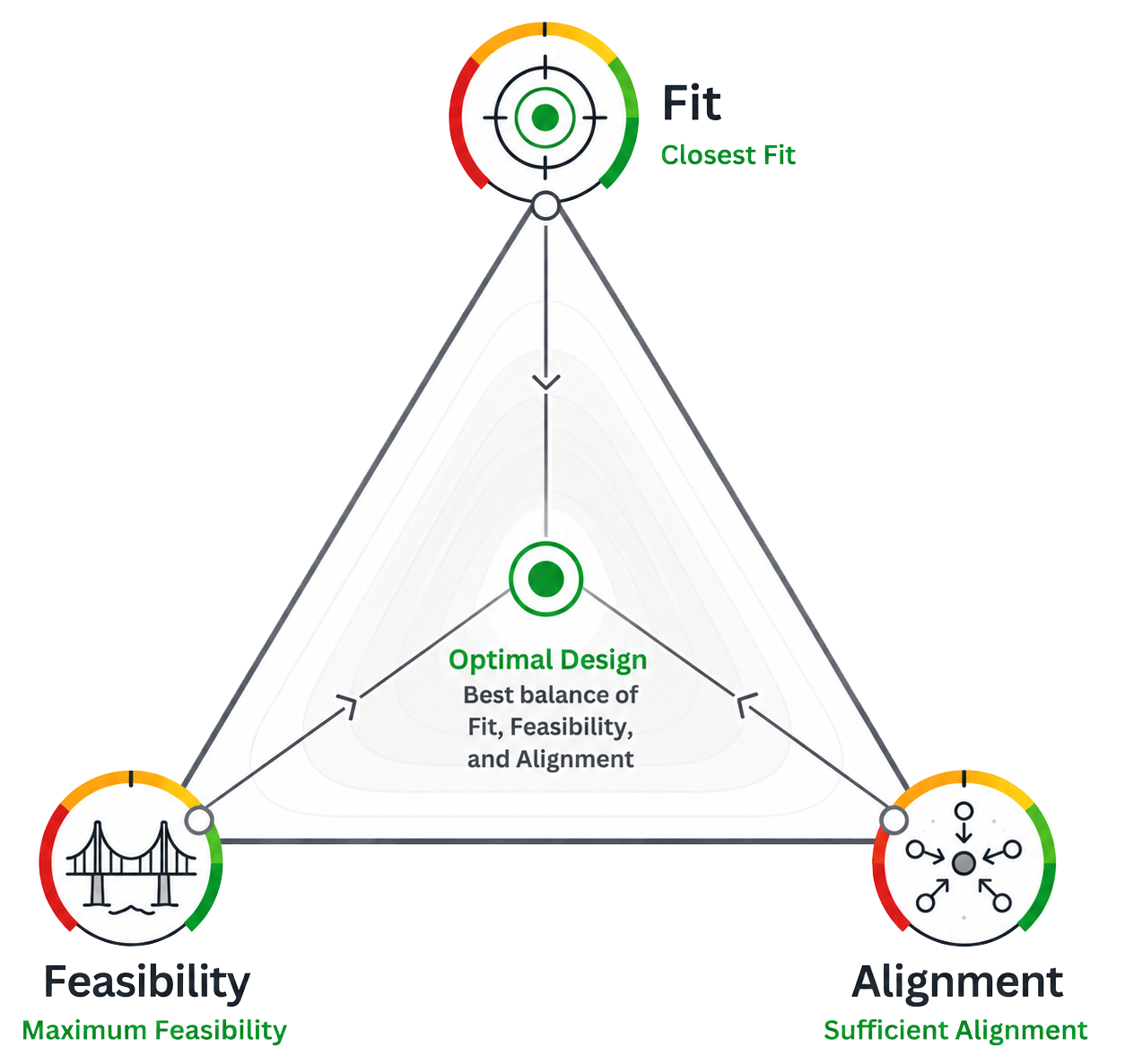
That layer runs on Constructive GDM. It is the inherited default: the sum of who is in the room, whatever facilitation approach the consulting team uses, and whatever time the engagement structure allows for the design work. It produces decisions that look complete. Research across 600+ real-world group decisions shows they consistently are not — carrying unresolved fit, feasibility, and alignment problems that surface when the client moves from the strategy room to the work.
For consultants, the cost of incomplete group decisions arrives in two ways.
The first is client outcomes. A client that receives a strategy with unresolved fit problems pursues the wrong objectives. A transformation plan with feasibility gaps hits implementation blockers the consulting team didn’t anticipate. An organisational change program with alignment gaps fragments as different parts of the client organisation act on different interpretations of what was agreed. When these failures occur, they are attributed to implementation — to the client’s execution capability, to stakeholder resistance, to changing conditions. Rarely to the quality of the group decision design process that produced the goals.
The second cost is reputational. Consulting firms are judged on outcomes, not just outputs. A beautifully constructed strategy that fails in execution is a failed engagement, regardless of the quality of the analysis behind it. The gap between what consultants deliver and what clients achieve in execution is, in a significant proportion of cases, a GDM-Design gap — and it recurs with every engagement that doesn’t address it.
Optimal GDM is the research-based replacement for decades of Constructive GDM. It doesn’t replace consulting expertise, analytical frameworks, or the structured delivery approaches that define a firm’s methodology. It replaces the group decision design process that sits beneath them — the layer responsible for producing the goals and actions the client will actually pursue.
For consultants, this changes the quality guarantee they can make. The goals and actions that come out of an engagement using Optimal GDM are accurate and complete — not because the analysis was more rigorous, but because the group decision design process was structured to produce completeness rather than assume it. The gap between consulting output and client outcome closes. And when an existing decision has already gone wrong, Optimal GDM’s diagnostic capability identifies the actual design gap — giving consultants a precise basis for re-engagement rather than a post-mortem. Optimal GDM is being used across real-world decisions spanning corporate strategy, policy design, M&A, organisational transformation, and major change programs. It is available as education and training, as purpose-built software, and as a direct service.
Configure the information you want — choose your topics and how much depth you want on each.
Talk with someone at SchellingPoint about what this means for your organization.
Explore SchellingPoint’s education and training programs.
Learn how SchellingPoint can work directly on a consequential decision.
Talk with us about building Optimal GDM capability across your organization.