
Facilitators are brought in precisely because groups struggle to design good decisions on their own. Their role is to create the conditions for a group to do its best work — managing process, surfacing perspectives, keeping the session productive. The assumption embedded in that role is that if the process is well-facilitated, the output will be a good decision.
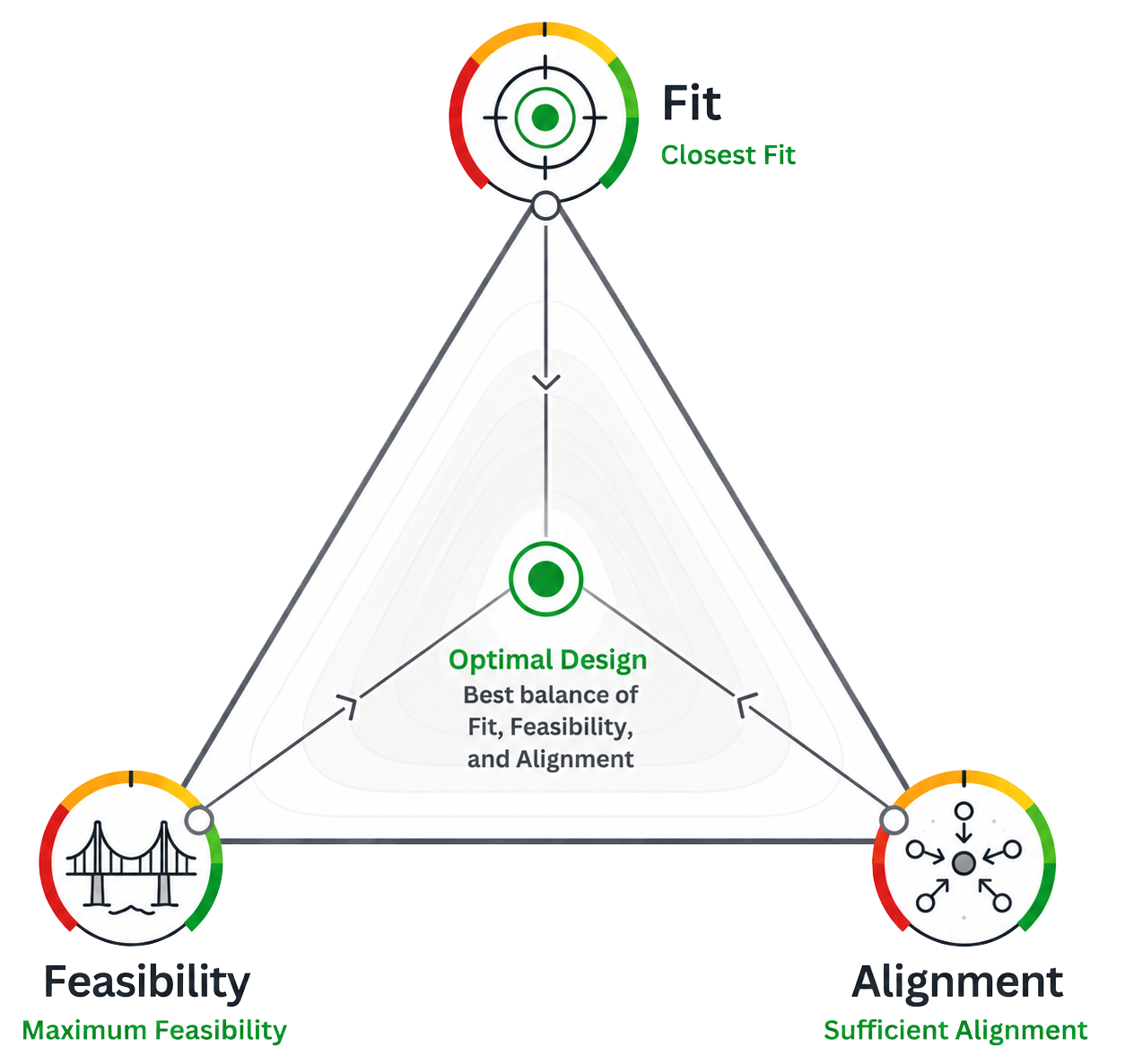
That assumption has a gap. Facilitation addresses how a group works together. It does not address the quality of the group decision design process — the specific methods used to produce accurate goals, resolve feasibility, and achieve genuine rather than assumed alignment. These are different things. A well-facilitated session using Constructive GDM produces a well-facilitated paper tiger.
For facilitators, Constructive GDM takes a particular form. Each engagement involves assembling a one-time group decision design process — selecting tools and techniques from the facilitator’s toolbox that seem right for this group, this topic, this room. The assembly is skilled work. But it is still a custom-built Constructive GDM process: unique each time, unverifiable in advance, and subject to the same quality leaks as any other inherited approach.
Research across 600+ real-world group decisions shows that Constructive GDM consistently produces goals and actions that are rational on the surface but carry unresolved fit, feasibility, and alignment problems into execution. The irony for facilitators is significant. They are the professionals most responsible for the quality of the group decision design process — and most likely to have their expertise defined by facilitation craft rather than GDM-Design capability.
When a facilitated session produces an incomplete decision, the facilitator carries a reputational cost they rarely see coming. The session felt productive. Participants were engaged. Agreement was reached. The facilitator did their job.
The incompleteness surfaces later — in execution, when the goals that seemed agreed begin to fragment, when feasibility problems appear that weren’t resolved in the room, when different participants turn out to have different understandings of what was decided. By then, the facilitator is gone. The gap is attributed to the group, or to implementation, or to changing circumstances. Not to the process that produced the decision.
The cost compounds when the facilitator is retained for follow-up work. A client that experienced a well-facilitated but incomplete decision is a client managing the consequences of a process that didn’t fully work — whether they know it or not.
Optimal GDM is the research-based replacement for decades of Constructive GDM. It doesn’t replace facilitation skill — the ability to read a room, manage group dynamics, create psychological safety, and hold a process together under pressure. It replaces the group decision design process that runs inside the facilitated session: the specific methods used to produce accurate goals, resolve feasibility, and verify alignment before the group leaves the room.
For facilitators, this is the upgrade that makes the facilitation matter more. The decisions that come out of a session using Optimal GDM are complete — verifiably so, before the group disperses. The gap between what the session produced and what holds in execution closes. And the facilitator’s value shifts from managing process to guaranteeing outcome quality — a significantly stronger professional position.
Many of the behavioral challenges that require skilled intervention in a Constructive GDM session — dominant voices, resistance to challenge, ambiguity about what the group is actually deciding — are symptoms of a process without structure, not of the people in the room. Optimal GDM prevents or heavily reduces these problems by giving the group a clear, shared process to follow. The facilitator’s primary role becomes Decision Guide: navigating a structured process toward a verifiable outcome. The Master Facilitator skillset — managing conflict, navigating power dynamics, holding a room together under pressure — doesn’t disappear. It becomes the mode the facilitator shifts into when it genuinely matters, rather than the constant effort required just to keep an unstructured process moving.
There is also a practical efficiency benefit. The current model — assembling a bespoke process from the facilitator’s toolbox for each new group — is replaced by a repeatable plug-in. Optimal GDM and SchellingPoint’s purpose-built software give facilitators a structured, proven process they can bring to any group decision design engagement, without the effort of custom assembly. Less preparation time. Consistent quality. Higher client outcomes across every engagement, not just the ones where the assembly happened to work.
Optimal GDM is being used across real-world decisions spanning corporate strategy, policy design, M&A, organisational transformation, and major change programs. It is available as education and training, as purpose-built software, and as a direct service.
Configure the information you want — choose your topics and how much depth you want on each.
Talk with someone at SchellingPoint about what this means for your organization.
Explore SchellingPoint’s education and training programs.
Learn how SchellingPoint can work directly on a consequential decision.
Talk with us about building Optimal GDM capability across your organization.