Group Decision Quality

The missing keystone.

It's hard to create good when you don't know what good looks like.

Before
Implementation

This is some text inside of a div block.
Decision-making theory states that the quality of the process drives decision quality.
So how can a group validly claim they made the best possible design when they don't know the quality of their decision design process?
Most claims of right, correct, and best are inaccurate inferences.

Before Implementation

After Implementation

Some judge a decision's quality after its implementation, based on the outcomes.
This ignores the roles implementation quality and luck play in the result.
Most assessments are inaccurate attributions to the decision's quality.

Before Implementation

Between

After Implementation

Groups have lacked a direct way to assess design quality at the point Decision Made is declared.
Assessments of fit, feasibility, and alignment are often highly inaccurate.
Many false positives, paper tigers, are being moved into implementation.

Before Implementation

Decision Design Quality

After Implementation

Previously, not explicit characteristics the content needed to support.
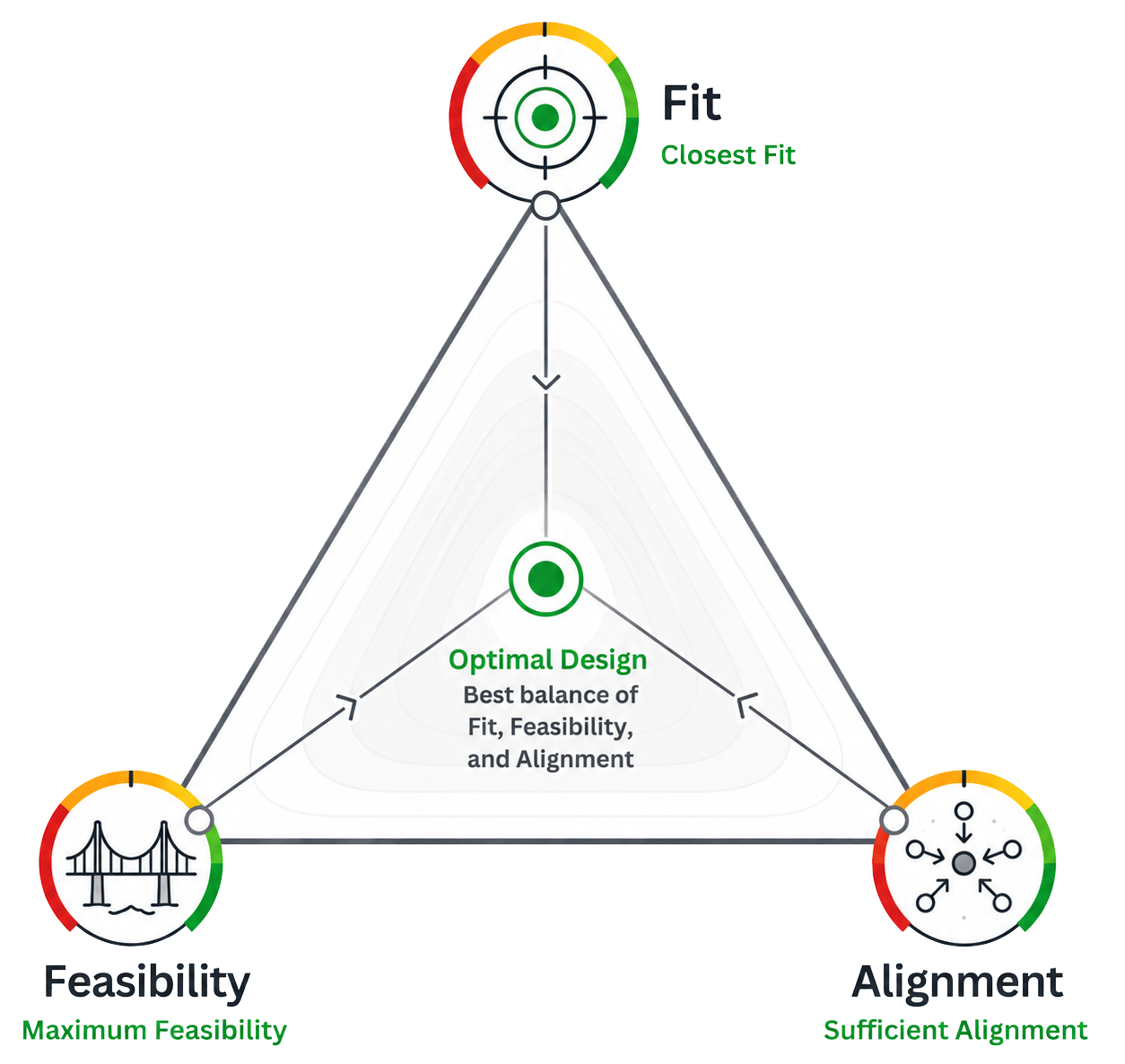
Groups need to produce goals and actions with three essential characteristics:
Fit, Feasibility, and Alignment
Now, groups know the quality not just the content going into implementation.
Previously, almost anything was better than the starting point.
Closest Fit: The goals are the most appropriate response to the Cost of Inaction.
Groups can more accurately right-size their objectives.
Previously, beyond technical issues, feasibility was a discussion for 'later.'
Maximum Feasibility: Known and knowable constaints have been surfaced and mitigated. The plan includes valid safeguarding actions.
Implementation timelines and costs are more realistic.
Previously, alignment was an intangible platitude described as all or nothing.
Sufficient Alignment: The consequential non-likemindedness has been surfaced and reconciled into aligned action.
Implementation starts with commitment on the consequential matters.

oFFA

Optimal Fit, Feasibility, and Alignment
Humans cannot truly optimize multiple synergistic and conflicting objectices. Special mathematics are required.
The SchellingPoint concepts and methods enable groups to get beyond 'our best' and false positives to 'excellent'. Software enables them to design 'best possible'
Why has there been no standard way to assess a decision's design quality as it is made?
There is academic study focused on decision quality and a small number of methodologies. However, they are mostly used in regulated industries and on large, critical decisions. No specification has found its way into business and industry that any group can readily use in any situation.
I regularly hear colleagues saying their team or a group has created the best set of goals and plans. Are they being untruthful?
They are most likely making the common and rational, but inaccurate design assets inference. Lacking a way to directly assess the quality of their goals and plans, groups are left to use the quality of the input data, the quality of the group members, the reputation of a consultant or facilitator, the quality of the dialogues, the richness of the activities, the feeling of their output's correctness to infer the quality of their output.

Why was this important decision-making item not closed sooner?
We believe it is primarily due to Group Design being seen as a 'push' process. Data and people are put in the front end. Goals and actions come out the other end. But at the start, few leaders, consultants, or facilitators have a framework defining Done. Inspecting group design as a repeated activity drove the standard process thinking of needing to define the output's required quality characteristics.
FAQ
Frequently asked questions
Why has there been no standard way to assess a decision's design quality as it is made?
I regularly hear colleagues saying their team or a group has created the best set of goals and plans. Are they being untruthful?
Why was this important decision-making item not closed sooner?