
Line managers lead more group design activities than any other role in the organization. Some of that work is internal — setting direction for a team, designing an improvement or transformation initiative, defining how a project will be scoped and delivered, establishing the policies and working practices the team will operate within. Some of it is lateral — working with peer line managers to design the cross-functional goals and actions that executives have commissioned. In both directions, the quality of what comes out of the group design process determines what gets built, what gets delivered, and what the executive receives.
All of it — from a team strategy session to a project kickoff — goes through a group decision design process that has never been examined.
That process is Constructive GDM. It is the default: the sum of who is in the room, what time pressure they’re under, and whatever facilitation instincts the group brings. It produces something that looks like a decision — a set of goals, a plan, a next step everyone agreed to. What it doesn’t reliably produce is a decision that is complete.
Some line managers also work within formal improvement methodologies — DMAIC, Kaizen, 8D, and others — that structure how groups engage with specific types of problems. These are not GDM-Design processes. They are purpose-built frameworks that rely on the quality of the group decision design happening inside them. DMAIC doesn’t specify how to design an accurate and complete improvement goal — it assumes the group can do that. That assumption is where Constructive GDM operates, and where the quality leak begins.
At the line manager level, the cost of incomplete group decisions is measured in rework, realignment, and time.
When a team scopes a project without fully resolving what success looks like, the project gets rescoped. When a resource allocation decision leaves feasibility gaps unresolved, the gaps become blockers. When a problem-solving session produces goals the team aligned to in the room but not outside it, the manager carries the gap — in follow-up conversations, in repeated meetings, in decisions that have to be made again.
There is also an upstream cost. The decisions line managers design don’t stay at the team level. They feed into the plans and priorities that executives receive and act on. A paper tiger produced at the team level becomes the executive’s incomplete input. The quality leak in Constructive GDM doesn’t stop at the line — it propagates.
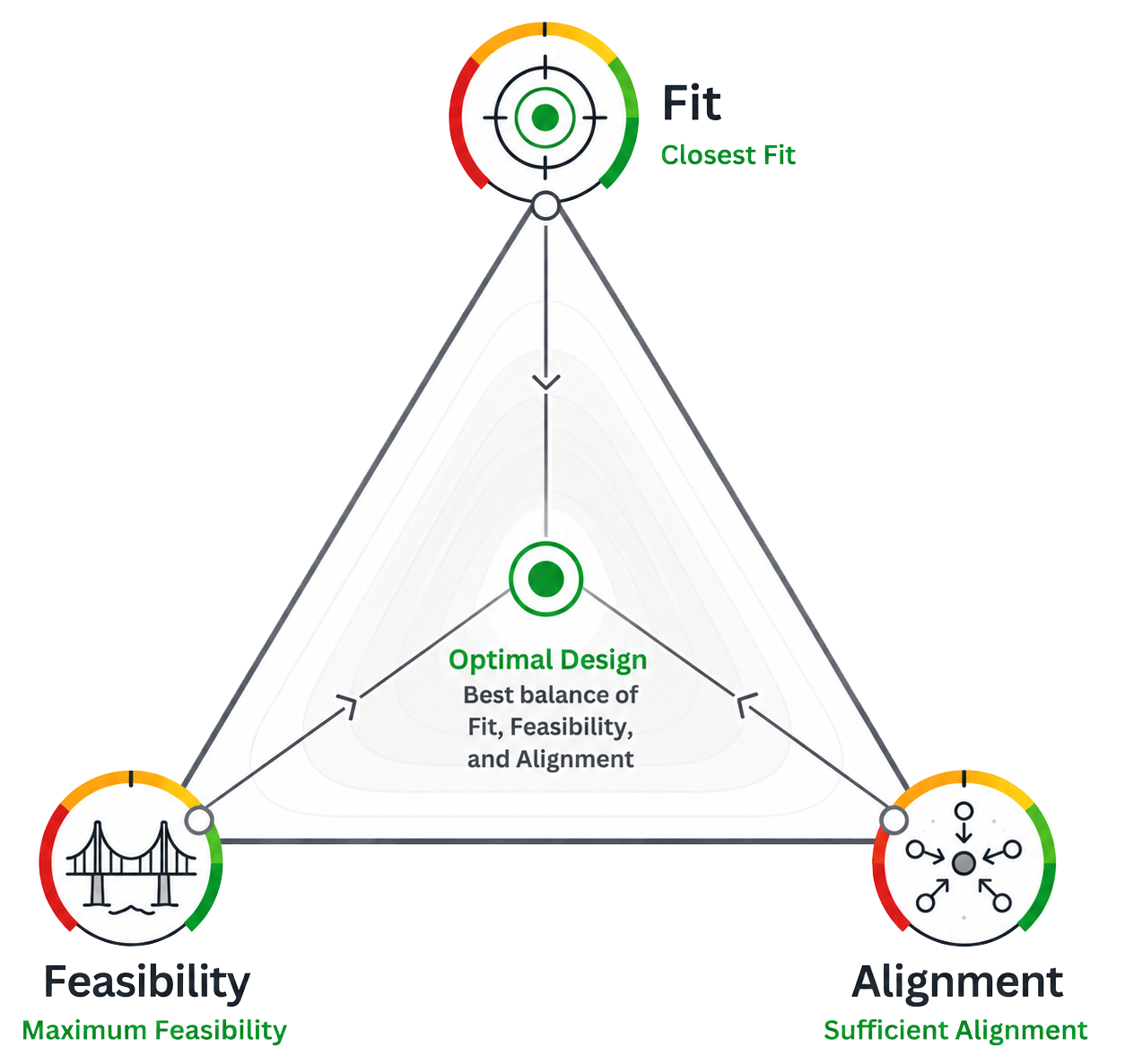
Optimal GDM replaces the inherited, improvised group decision design process with one that is structured, verifiable, and designed to resolve fit, feasibility, and alignment before execution begins.
For line managers, this is a practical change — not an organisational one. You don’t need to redesign how your team works. You need a process that produces complete decisions reliably, at the pace and scale of the decisions you’re actually running. Optimal GDM’s structured approach closes the gaps that Constructive GDM leaves open — so that what the team agrees to in the room is what holds in the work. Optimal GDM is being used across real-world decisions spanning corporate strategy, policy design, M&A, organisational transformation, and major change programs. It is available as education and training, as purpose-built software, and as a direct service.
Configure the information you want — choose your topics and how much depth you want on each.
Talk with someone at SchellingPoint about what this means for your organization.
Explore SchellingPoint’s education and training programs.
Learn how SchellingPoint can work directly on a consequential decision.
Talk with us about building Optimal GDM capability across your organization.