
Policy makers design decisions that govern how organizations, institutions, and governments act. The stakes are high, the stakeholders are many, and the processes are often formal — consultation rounds, working groups, cross-agency panels, ministerial briefings. What those processes rarely include is a reliable method for ensuring that the goals and actions they produce are accurate, complete, and genuinely aligned.
Every policy design process has a group decision design layer — the point at which a group of people, however expert and well-intentioned, must translate analysis, consultation, and competing interests into a specific set of goals and actions. That layer runs on Constructive GDM: the inherited default, shaped by whoever is at the table, whatever facilitation approach the process lead uses, and whatever political or timeline pressure the group is under.
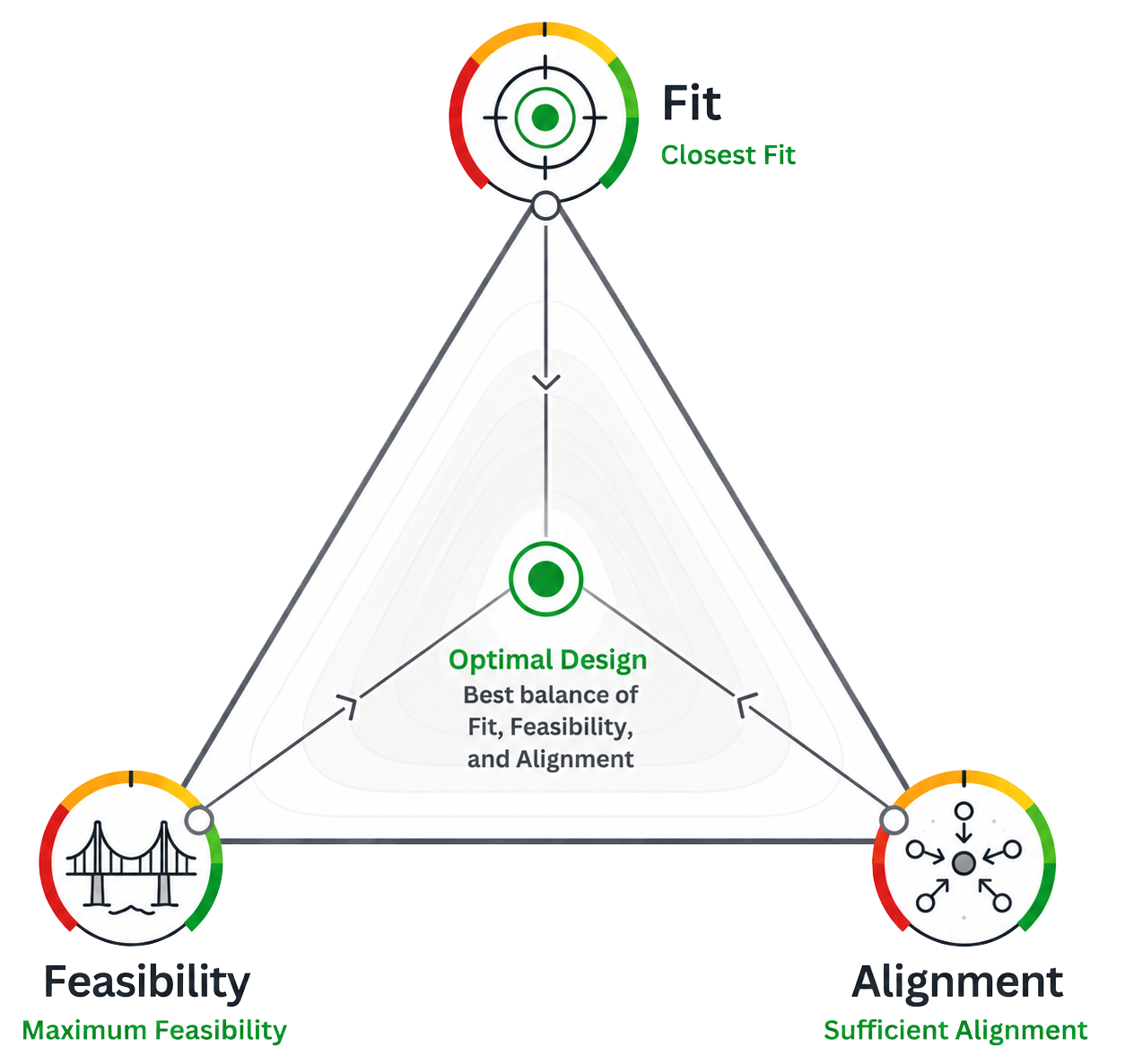
Research across 600+ real-world group decisions shows that Constructive GDM consistently produces goals and actions that are rational and defensible on the surface, but carry unresolved fit, feasibility, and alignment problems into implementation. In policy, those problems don’t surface in a boardroom — they surface in delivery failures, community impact gaps, and implementation costs that bear no resemblance to what the policy process anticipated.
Policy failures are rarely failures of intent. They are failures of design — specifically, failures in the group decision design process that produced the policy’s goals and actions.
A policy goal with unresolved fit problems pursues outcomes that don’t match the actual situation the policy is meant to address. A policy with feasibility gaps gets implemented at a cost — in time, money, and political capital — that the design process didn’t anticipate. A policy with alignment gaps fragments during delivery, as different agencies, departments, or stakeholder groups act on different interpretations of what was agreed.
The cost is amplified by scale. Policy decisions cascade. A goal that leaves the design process incomplete doesn’t affect one team — it affects every part of the system responsible for delivering it. And the longer incomplete goals stay embedded in policy, the more expensive they become to correct.
Optimal GDM is the research-based replacement for decades of Constructive GDM. It doesn’t replace policy expertise, stakeholder consultation, or analytical rigor. It replaces the group decision design process that sits beneath them — adding a structured, verifiable layer that resolves fit, feasibility, and alignment before policy goals enter implementation.
For policy makers, this changes what they can stand behind. The goals that come out of a policy design process using Optimal GDM are accurate and complete — not because the consultation was broader or the analysis was deeper, but because the group decision design process was structured to produce completeness rather than assume it. When a policy falls short in delivery, Optimal GDM’s diagnostic capability identifies the actual root cause — the design gap that wasn’t resolved — providing a clear basis for revision rather than attribution of blame. Optimal GDM is being used across real-world decisions spanning corporate strategy, policy design, M&A, organisational transformation, and major change programs. It is available as education and training, as purpose-built software, and as a direct service.
Configure the information you want — choose your topics and how much depth you want on each.
Talk with someone at SchellingPoint about what this means for your organization.
Explore SchellingPoint’s education and training programs.
Learn how SchellingPoint can work directly on a consequential decision.
Talk with us about building Optimal GDM capability across your organization.