
Project managers are responsible for delivering what was decided. But before delivery begins, there is a design phase — the point at which a group must define what the project is actually trying to achieve: the goals, the constraints, the scope, the success criteria, the accountabilities. That phase is group decision design, and it determines the quality of everything the project manager is then asked to deliver.
Most project managers inherit the output of that design phase rather than designing it themselves. The brief arrives — a set of goals, a scope statement, a charter — and the project manager’s job begins. What they rarely get to examine is whether the process that produced the brief was designed to produce accurate and complete outputs, or whether it produced the most available ones.
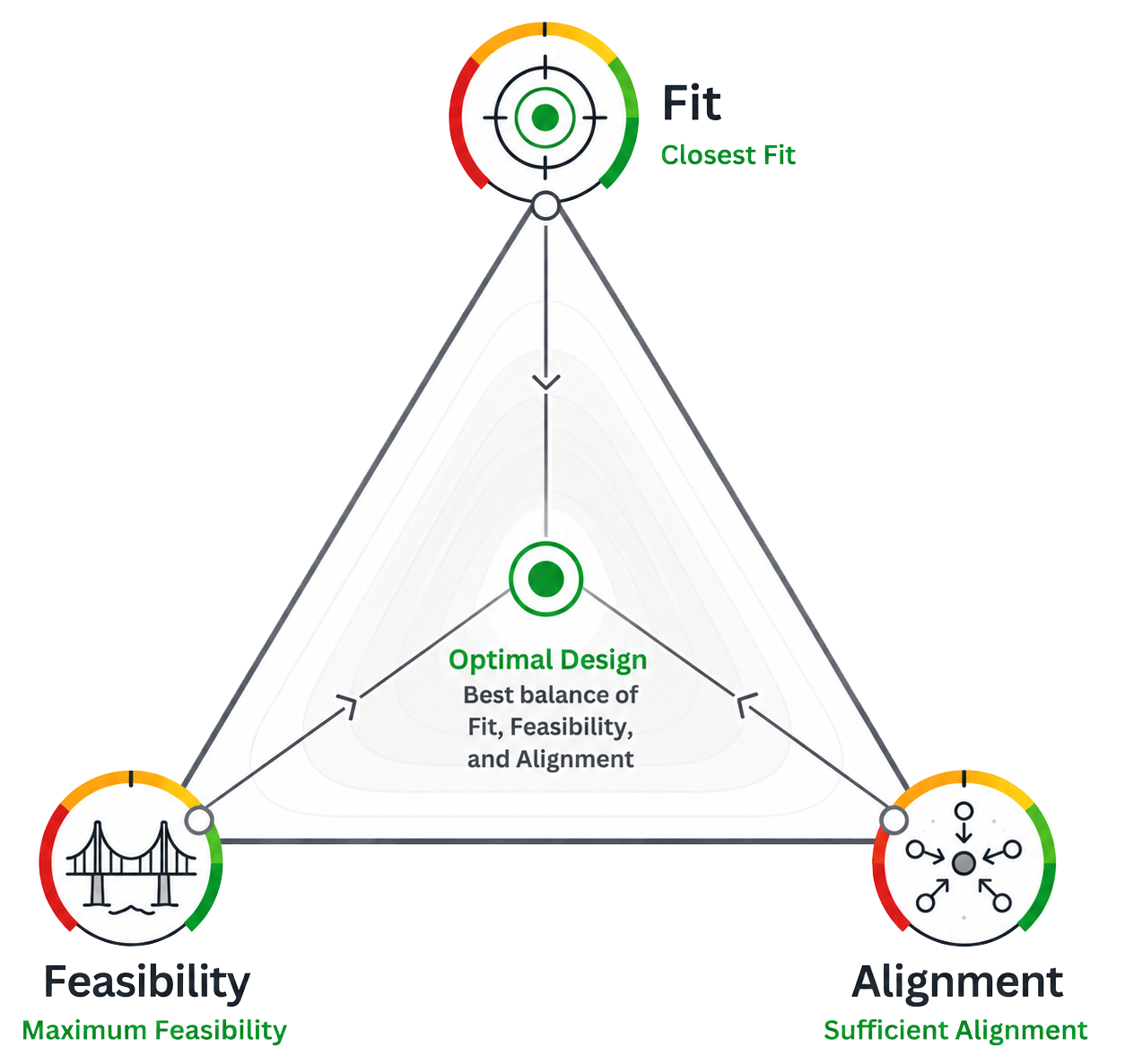
The answer, in almost every organisation, is the latter. The group decision design phase that precedes most projects runs on Constructive GDM — the inherited default. Research across 600+ real-world group decisions shows that this process consistently produces goals and actions that are rational and logical on the surface, but carry unresolved fit, feasibility, and alignment problems. For project managers, those problems don’t stay in the brief. They become the project.
Project managers are expert at managing uncertainty, adapting to change, and keeping delivery on track under pressure. What they are less often given is a project that was fully and accurately designed before they were handed it.
Scope creep is not primarily a delivery problem — it is a design problem. The scope that grows during delivery is the scope that wasn’t fully resolved during design. Feasibility issues that surface mid-project are not surprises — they are unresolved design gaps that survived the project charter. Alignment failures between stakeholders during delivery are the downstream consequence of assumed rather than genuine agreement at the design stage.
Project managers absorb these costs as delivery problems. They manage them with change controls, escalations, revised timelines, and renegotiated scope. Each of these is real work — skilled, necessary work — applied to a problem that a better group decision design process would have prevented.
There is a further irony in project recovery. When a project goes wrong, the response is typically a group process — a root cause analysis session, a re-alignment workshop, a recovery plan. These are group decision design activities running on Constructive GDM. Using a C-GDM-based process to solve a problem caused by C-GDM. Program managers tasked with rescuing troubled projects are, in most cases, applying the same unexamined approach to diagnose and fix a failure that the same unexamined approach created.
Optimal GDM is the research-based replacement for decades of Constructive GDM. For project managers who also lead or participate in the design phase, it replaces the inherited group decision design process with one that is structured, verifiable, and designed to resolve fit, feasibility, and alignment before the project brief is finalised.
For project managers who inherit the brief, Optimal GDM changes what they can ask for and verify. A project designed using Optimal GDM produces goals that are accurate and complete — not because the stakeholders were more engaged, but because the process was structured to resolve the problems that Constructive GDM leaves open. The brief that lands on the project manager’s desk is a steel lion, not a paper tiger. And when a project has already gone wrong, Optimal GDM’s diagnostic capability identifies the actual root cause — the specific design gap — rather than running another C-GDM-based recovery process over the same unresolved problems. Optimal GDM is being used across real-world decisions spanning corporate strategy, policy design, M&A, organisational transformation, and major change programs. It is available as education and training, as purpose-built software, and as a direct service.
Configure the information you want — choose your topics and how much depth you want on each.
Talk with someone at SchellingPoint about what this means for your organization.
Explore SchellingPoint’s education and training programs.
Learn how SchellingPoint can work directly on a consequential decision.
Talk with us about building Optimal GDM capability across your organization.