
Relationship managers sit at the boundary between their organization and the clients, partners, alliance members, coalition parties, and stakeholders they serve. Much of their most consequential work is group decision design — collaboratively defining what the relationship will produce and how so that 1+1>2, aligning on goals across organizational boundaries, designing joint initiatives where more than one party has to agree on what success looks like and how to get there.
What makes this structurally harder than internal group design is that in most collaborative relationships, each party brings their own relationship manager — and their own Constructive GDM approach. Two or more inherited group decision design processes meet at the table, each with its own defaults, each producing something that looks like agreement. The risk of incompleteness is not just present — it is multiplied.
And there is a further complication unique to collaborative relationships. The desire to work together — the very thing that fuels them — is also what suppresses the challenges that would surface incomplete goals. In a joint design session, no one wants to disrupt the goodwill by questioning a goal that feels agreed to. Misaligned objectives, unresolved feasibility, assumed alignment: these don’t get raised. They get embedded in the relationship instead, and surface in the work.
Relationship managers experience the cost of incomplete group decisions differently from other roles. The gap doesn’t show up as internal rework — it shows up in the relationship itself.
A joint initiative designed with unresolved fit problems delivers outcomes neither party actually needed. A collaboration with feasibility gaps hits blockers during delivery that both parties must now manage. A goal set where alignment was assumed rather than resolved produces the kind of misunderstanding — about scope, accountability, and what was agreed — that requires escalation to fix. In alliances and coalitions, where the relationships span organizations and often geographies, these gaps are harder to catch and more expensive to correct.
Each of these failures is relationship damage. And relationship damage is expensive in ways that don’t appear in project budgets — in eroded trust, reduced renewal likelihood, and the time spent managing a situation that a better group design process would have prevented.
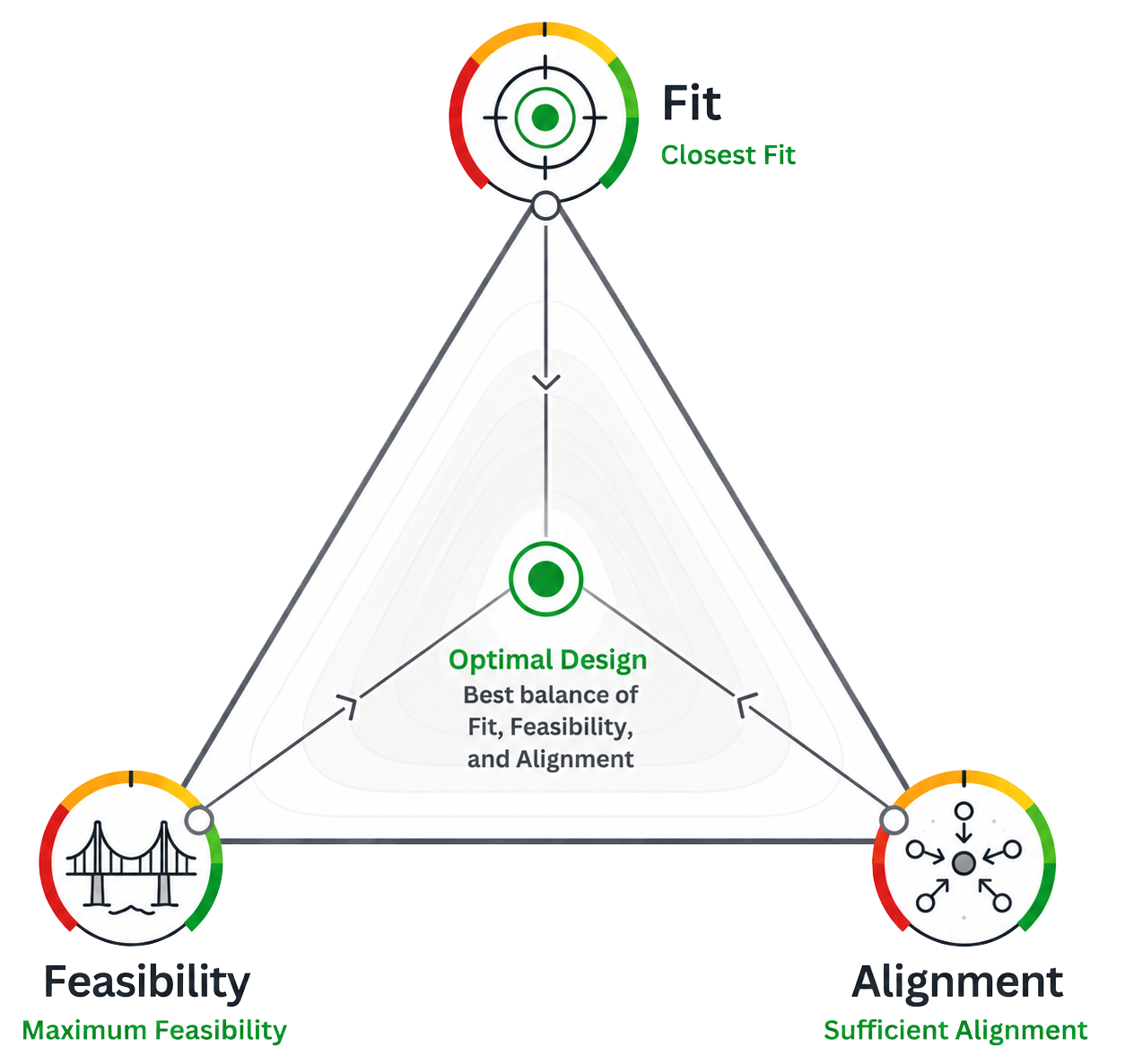
Optimal GDM is the research-based replacement for decades of Constructive GDM. It doesn’t change who is at the table. It changes the process they use — replacing two or more inherited, improvised approaches with a single structured, verifiable process designed to resolve fit, feasibility, and alignment before goals are committed to.
For relationship managers, this changes what gets agreed to across organisational boundaries. The goals and actions that come out of a collaborative design session using Optimal GDM are accurate and complete — not because the relationship is stronger, but because the process replaced the dynamic where goodwill suppresses challenge with one where completeness is verified. The result is joint decisions that hold under delivery pressure, rather than ones that require renegotiation when the gaps surface. Optimal GDM is being used across real-world decisions spanning corporate strategy, policy design, M&A, organisational transformation, and major change programs. It is available as education and training, as purpose-built software, and as a direct service.
Configure the information you want — choose your topics and how much depth you want on each.
Talk with someone at SchellingPoint about what this means for your organization.
Explore SchellingPoint’s education and training programs.
Learn how SchellingPoint can work directly on a consequential decision.
Talk with us about building Optimal GDM capability across your organization.