
Strategy developers design the processes by which organizations make their most consequential decisions. The frameworks they use — competitive analysis, scenario planning, portfolio review, strategic planning cycles — provide structure for the content of strategy. What they don’t provide is a reliable group decision design process for producing accurate and complete strategic goals.
That distinction matters. Every strategy process has two layers. The first is analytical — gathering data, evaluating options, modeling scenarios. Strategy developers are typically strong here. The second is group decision design — the process by which a group translates analysis into goals, constraints, and plans of action that the organization will be held to. This is where Constructive GDM operates.
Constructive GDM is the default group decision design process in every strategy cycle that hasn’t deliberately replaced it. It is not chosen — it is inherited. It is the sum of whoever is in the room, whatever facilitation approach the strategy lead defaults to, and whatever pressure the timeline creates. Research across 600+ real-world group decisions shows that this process consistently produces goals that appear sound but carry unresolved fit, feasibility, and alignment problems — problems that surface when the strategy moves from the planning room into execution.
Strategy developers are often the last to see this, because their expertise is in the analytical layer. The GDM-Design layer runs beneath it, invisible, producing outcomes that look like strategy.
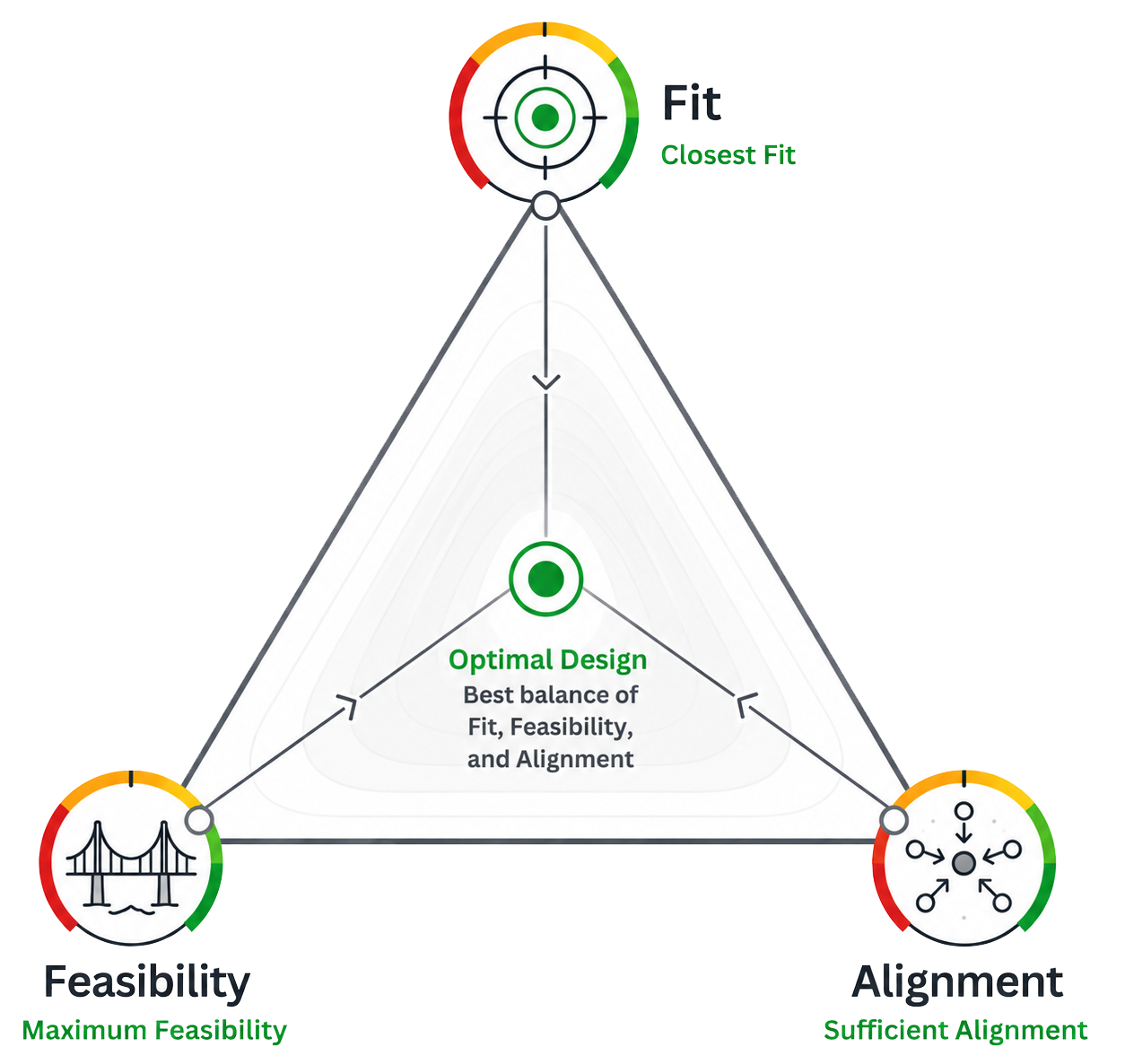
When a strategy process produces goals with unresolved fit problems, the organization pursues objectives that don’t match its actual situation. When it produces feasibility gaps, the organization commits to actions it cannot deliver. When it produces assumed rather than genuine alignment, the strategy fragments during execution as different parts of the organization act on different interpretations of what was decided.
Strategy developers experience this as a credibility problem. The frameworks were right. The analysis was sound. But what came out of the group design process wasn’t a complete decision — and the gaps didn’t show up until the organization was 12 or 18 months into delivery.
There is also a cascade effect. Strategic goals become the commissioning brief for every downstream group design activity — the transformation programs, the project portfolios, the team-level planning cycles. A goal that leaves the strategy process with unresolved problems doesn’t stay at the top. It propagates as an incomplete input into every decision that follows it.
Optimal GDM is the research-based replacement for decades of Constructive GDM. It doesn’t replace strategic frameworks or analytical methods. It replaces the group decision design process that sits beneath them — adding a structured, verifiable layer that resolves fit, feasibility, and alignment before strategic goals leave the planning process.
For strategy developers, this changes what they can guarantee about their output. The goals that come out of a strategy process using Optimal GDM are accurate and complete — not because the analysis was better, but because the group decision design process was designed to produce completeness rather than assume it. When a strategy fails in execution, Optimal GDM’s diagnostic capability identifies the actual root cause — the specific design gap that wasn’t resolved — rather than attributing failure to implementation quality or organisational resistance. Optimal GDM is being used across real-world decisions spanning corporate strategy, policy design, M&A, organisational transformation, and major change programs. It is available as education and training, as purpose-built software, and as a direct service.
Configure the information you want — choose your topics and how much depth you want on each.
Talk with someone at SchellingPoint about what this means for your organization.
Explore SchellingPoint’s education and training programs.
Learn how SchellingPoint can work directly on a consequential decision.
Talk with us about building Optimal GDM capability across your organization.