
"The leader told us the reason for the workshop was x, y, and z. I didn’t agree but he didn’t ask whether we agreed; we were being told."
"I didn't agree with one of the main goals being proposed, but the sentiment in the room was very much for it, and I didn't want to be that frustrating naysayer."
"I mentioned two problems. I could actually see seven or eight, but didn't want to come across as not supporting the project."
How group decisions take shape
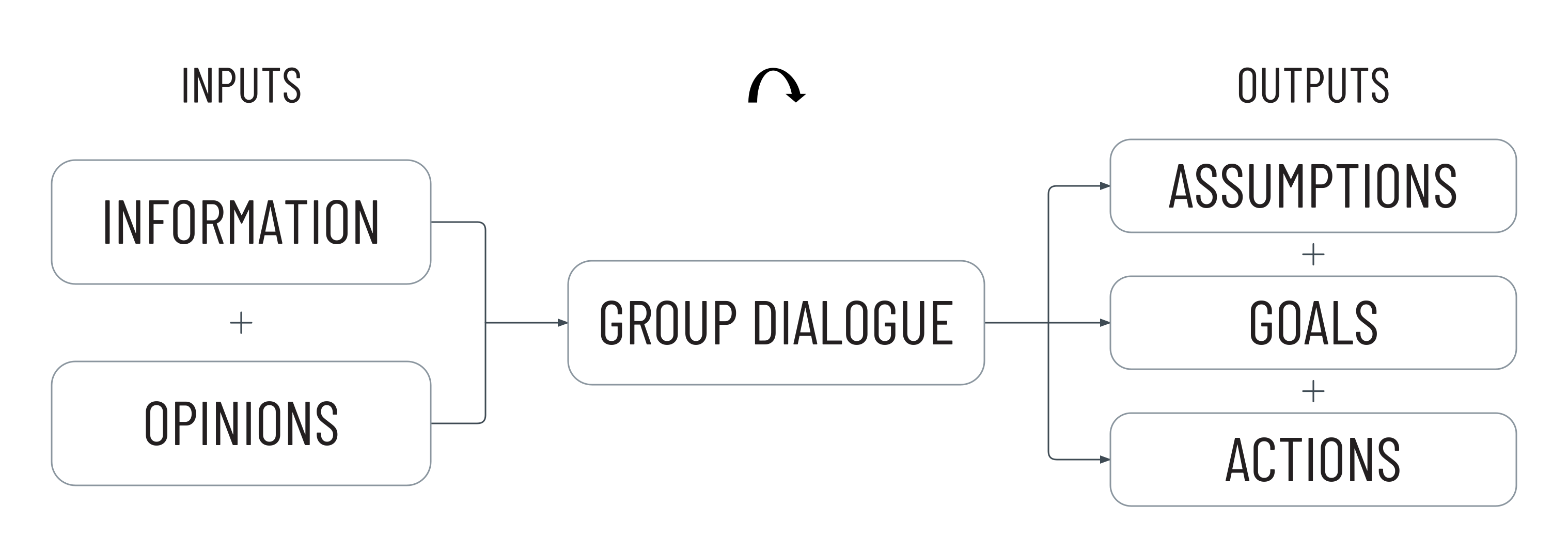
Groups use information and people’s opinions to examine assumptions, set goals, and choose actions.
They do this through group dialogue.
To be available for use, relevant information needs to be gathered. Relevant opinions need to be expressed.
Valuable but Significantly Incomplete
Our research found that traditional interviews and workshops surface up to 50% fewer opinions than exist within a group.
Silently rejected assumptions, omitted requirements, and unresolved concerns do not enter traditional conversations.
Consequently, many groups’ proposed goals and actions feel logical and convincing, but are invisibly inaccurate and incomplete.

The cost during implementation
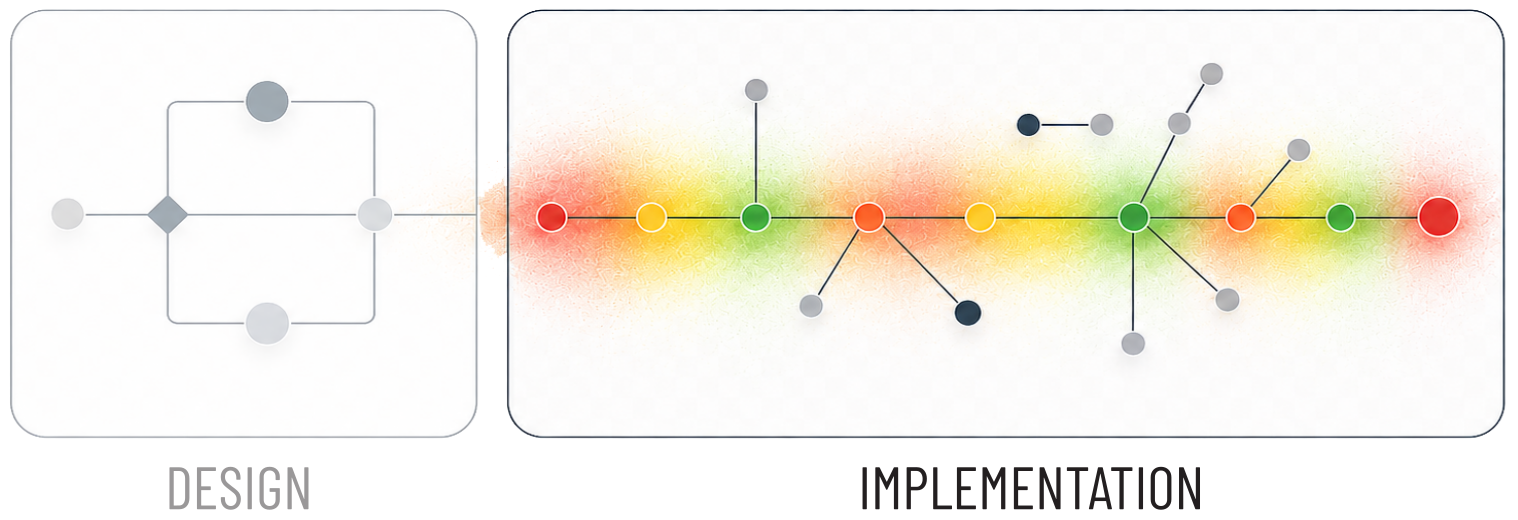
Opinions withheld during planning often show up later as inaction, delays, or conflicting actions.
The group then spends time resolving differences, reworking plans, and revisiting decisions.
Insufficient personal safety is a pre-implementation contributor to missed goals, deadlines, and budgets.
What is going on?
People judge the consequences of speaking before deciding what to share. Psychological Safety is the group’s shared belief that asking questions, expressing different views, and acknowledging mistakes will not lead to humiliation or punishment. Personal Safety is an individual’s confidence, in a particular conversation, that expressing a specific thought will not bring negative consequences for them or others.
The View of Conversation™ Frame
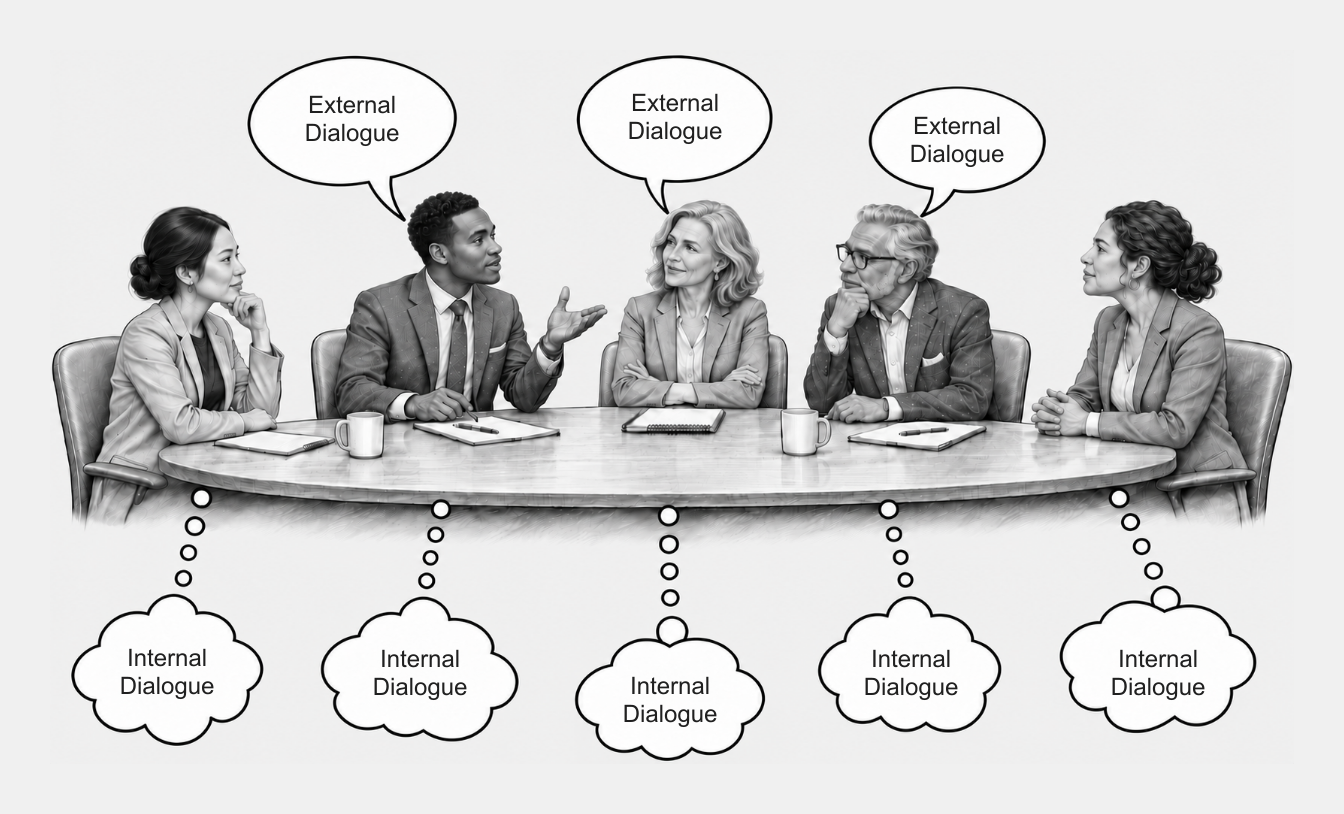
The View of Conversation™ explains the relationship between relevant thinking we keep unshared (Internal Dialogue) and what we express verbally or in writing (External Dialogue).
The diagram is illustrative. The bubbles’ relative sizes vary by person and context.
Internal Dialogue
External Dialogue

Unavailable
Available
Genuine
Masked
Hover over (or tap) any label to see its definition.
Shared privately, withheld from the group
A concern shared privately with a colleague might remain unavailable to the decision-making group.
A participant withholds a concern in the meeting because of someone else’s presence, then shares it with a trusted colleague afterward. It is Unavailable Internal Dialogue in the meeting and Genuine External Dialogue in the private exchange.
The same distinction applies during the meeting itself. Two colleagues exchange texts across the table while staying silent in the group discussion. Their concern is shared between them and remains unavailable to the group:
Colleague
Across the table
This is never going to work.
Why is no one talking about the problem with x?
Too scared.
Do you think they’ll figure it out? I’m not mentioning it.
Eventually.
When does what goes unsaid matter?
Masked External Dialogue helps keep relationships operating. We soften a response, spare someone embarrassment, or avoid opening a conversation we do not want or need to have. Relationships do not require us to share every thought.
“How was your day?”
“Good.”
Privately, you are thinking, “Something frustrating happened, but I’d rather leave it at work.” The answer lets the conversation move on. Where nothing consequential depends on a fuller account, there is no adverse effect.
Now consider a different exchange.
“Are you still okay looking after Dad every day?”
“Yes. It’s a lot, but we’re managing.”
Privately, the person is thinking, “I can’t keep doing this. I’m exhausted, and it’s putting a strain on my marriage. But if I say so, they’ll think I don’t want to look after him.”
The siblings leave the care arrangements unchanged, believing the current plan is working. It depends on a commitment that one person is no longer able to sustain but feels they can't express.
What goes unsaid matters when the decision depends on it.
This distinction is critical within business conversations. Many unspoken thoughts have no bearing on the work. Others contain a requirement, a barrier, a mistaken assumption, or a reservation about taking action that the group needs to understand.
Five real-life examples
These five dialogues are edited reconstructions of real-life cases.
1. Vice-President and Direct Report
A Vice-President and one of her Direct Reports
Vice-President
I was thinking over the weekend about that client issue. How about we do ‘x’? That should get things back on track. What do you think?
Direct Report
Yes, that has potential.
Scenario 1: reveal his Internal Dialogue
Wow, great idea. I would never have thought of that.
I can think of three things to do right now to make it happen. When this talk is over, I’m off to start working on them.
Of course, I can’t say all that. I’d sound like I’m creeping all over the boss, and I might not appear too smart; should I have thought of it? I’ll play it low key.
Scenario 2: reveal his Internal Dialogue
Oh heck, here we go again. She must have been reading another HBR article over the weekend.
This will never work. I need to make sure it doesn’t go further.
Of course, I can’t say that. If I did, I’d offend her, which would hurt her view of me, and I’d make myself appear not too smart for thinking it’s bad. So I’ll play it low key for now.
What do both scenarios have in common?
He says the same words either way. Whether his Internal Dialogue is positive or negative, he keeps it internal for his own safety.
The false signal the Vice-President receives
Either way, she hears mild support. In Scenario 1 she never learns that she has an enthusiastic ally with three actions ready to go. In Scenario 2 she proceeds believing the idea has backing, while her Direct Report intends to make sure it goes no further.
2. Buyer and Sales Representative
A Buyer and a Vendor’s Sales Representative
John, Buyer
Jane, nice to see you again. I can’t believe it’s already six months since we had that last account review. This one will be a bit different. It shouldn’t take as long, as we have some changes that I want to tell you about.
Jane, Account Manager
Yes, that last one was a long meeting. If I can help make this one shorter and smoother, just let me know.
Reveal her Internal Dialogue
Hmm, this doesn’t sound good. Not take as long. Changes.
John, Buyer
Well, I can get to the heart of it immediately. We have been revising our long-range forecasts and, given what we see ahead in the sales mix, we’re going to be needing far less of your raw materials. That’s the core of it.
Reveal his Internal Dialogue
I am done with this vendor. Jane has been a great rep, but her firm has done nothing to address the issues we’ve had so that we’re getting what we need from them.
Jane, Account Manager
Heck, that is big news. Well, I suppose there is nothing I can do about that, is there? It makes sense that if you’re making less of the products for which we provide raw materials, that’s just the way it is.
Reveal her Internal Dialogue
Darn, there goes 30% of my commissions, all in one lost account.
At least I won’t get blamed for losing the account.
John, Buyer
That’s right. It’s nothing to do with you. You’ve been an outstanding account manager. You’ve been proactive, you’ve listened to my needs, you’ve been there when we needed something. This is nothing about you.
Reveal his Internal Dialogue
But her company has done nothing to back her up. If I tell her that, they’ll come charging in here with promises they won’t be able to keep.
Giving this reason for closing down buying from them does two things. It stops Jane getting into trouble, and it stops her execs wasting more of my time.
Jane, Account Manager
Thank you, John, I appreciate that feedback. Perhaps when things change and you need more of our materials again, we’ll get back to where we were.
Reveal her Internal Dialogue
Oh well. At least it really isn’t anything I did wrong. In the car I’ll write my trip report so my boss will see that it’s not our fault they’re going away.
How John left the conversation
John is pleased that he has been able to fire an unsatisfactory vendor who never responded to his needs, while ensuring that the account manager who didn’t receive support from her leadership doesn’t take any blame for losing the client.
How Jane left the conversation
Jane is disappointed that she has to go back to her company leadership and explain that they are losing a large client, but relieved that it is due to circumstances beyond her or their control.
The false signal Jane’s company receives
Jane’s trip report will tell her leadership that the account was lost to circumstances beyond their control. In fact, it was their own inaction that caused it. Because John’s Internal Dialogue stayed internal, the vendor never learns what it needed to fix.
3. HR Partner and Departing Employee
An HR Business Partner and a Departing Employee
Anita, HR Business Partner
Eric, thank you for taking this call to conduct your exit interview. We’re sorry that you’re leaving the company. I’m not here to talk you into staying; exit interviews help us learn what should be done to prevent losing great people like you in the future.
Reveal her Internal Dialogue
This is a real shame. Eric is one of our high-potentials we had great plans for. I’ll be really interested to learn why we’re losing him.
Eric, Departing Employee
Of course, Anita. I understand the need for exit interviews. Happy to answer your questions.
Reveal his Internal Dialogue
Danger, alert! Watch yourself, be careful what you say. Don’t share anything you might regret later.
Anita, HR Business Partner
If we can start with the headlines, could you describe what led to your decision to leave?
Eric, Departing Employee
I’ve had a great four years here. I’ve learned a lot. I’ve had some great challenges, worked with some great people, seen new ways of doing things. Overall, it’s been great. I just feel it’s time to move on now.
Anita, HR Business Partner
That’s wonderful to hear. I’m delighted you’ve had an environment here that’s allowed you to achieve all of that. So what has led you to decide to leave us now?
Eric, Departing Employee
It’s hard to pinpoint, really. I like the business we’re in, and see the range of companies out there, and rather than being in one company too long, I’d like to work in another business doing different things.
Reveal his Internal Dialogue
I don’t see where this company’s going. I’ve shared my views on that, but they’ve had no impact. Time to go somewhere that knows where it’s heading.
My manager hasn’t let me do what I wanted to, despite saying he would. I’ve tried to tell him but he doesn’t listen. There’s no point saying that; I’ll just get him into trouble.
And there’s no point trashing him or the company leadership because, who knows, this new job might not work out. I think they’d have me back here, so as they say, ‘Don’t burn any bridges.’
Anita, HR Business Partner
Well, that’s understandable. You’re one of our high-potentials and this is why: you see beyond your job and see a bigger picture. Perhaps you’ll come back to us in a few years and bring all that outside experience and industry knowledge into a leadership role?
Reveal her Internal Dialogue
This is a real shame. Eric is one of our high-potentials we had great plans for. And his reasons for going are very reasonable. I see why he’s a high-potential.
Eric, Departing Employee
I’m honored that you think the firm would rehire me. I appreciate that.
Reveal his Internal Dialogue
It’s nice to hear, but I hope it doesn’t come to that. Coming back would be my last resort.
How Anita left the conversation
Anita closes the exit interview disappointed that Eric is leaving, but satisfied that she understands his reasons. She leaves with an account of a happy employee seeking experience elsewhere.
How Eric left the conversation
Eric leaves the call pleased that it’s a win-win-win for all involved: the firm likes him, Anita has a positive explanation for his departure, and he hasn’t offended his former manager or others on the way out.
The false signal the company receives
Anita will report that Eric was a happy employee leaving to broaden his experience. His real reasons, that he does not see where the company is going and that his manager did not let him do what was promised, never reach leadership. The exit interview cannot do what Anita said it was for: prevent losing other great people.
4. Project Manager and Team Member
A Project Manager and one of his Team Members
Peter, Project Manager
So, we’ve talked about what this project’s about and what we need to achieve. Let’s look at the negative now, some risk analysis. So what risks do we need to factor in? Let’s get them all out on the table.
Tracy, Team Member
Well, I think there’s a concern among some of this team that the product development group in Palo Alto aren’t going to be ready in time.
Reveal her Internal Dialogue
This is pretty much common knowledge. I assume I wasn’t telling you something you didn’t already know.
Tracy, Team Member
Also, I think we’re going to have a problem with a shortage of SAP SMEs (subject matter experts). The business unit leaders said they wouldn’t let them go again after the Symphony project, that their extended absence hurt their operations.
Reveal her Internal Dialogue
Peter may not like this one, as he’s adamant that without SMEs these types of projects just don’t work. But he needs to hear the issue.
Peter, Project Manager
OK, Tracy, those are two good ones. Any others you are aware of?
Tracy, Team Member
That’s what’s on my mind. I think those are two big ones we should think about dealing with.
Reveal her Internal Dialogue
I have about six more issues we’ll need to deal with if this is to work, but I’m going to stop here before he thinks I’m too pessimistic and not a supporter of the project.
Peter, Project Manager
Right then. Does anyone else want to offer up any risks we should be taking care of?
How Peter left the conversation
Peter closes the meeting feeling confident he has done a good job surfacing the issues his project plan needs to recognize, and pleased with Tracy’s valuable contributions.
How Tracy left the conversation
Tracy makes valuable contributions to Peter’s project planning meeting while protecting her standing on the team and avoiding the impression that she opposes the project.
The false signal Peter receives
Peter believes the risks are out on the table and plans around the two he heard. Tracy sees about six more that must be dealt with if the project is to work. They stay out of the plan, and the project carries them unmanaged.
5. New CEO and CIO
A new CEO and her CIO
Susan, New CEO
John, just a quick call ahead of the meetings we’re going to be starting next week on the new Omni-Channel strategy. I just want to cover off a few items with you directly before we get embroiled in the meetings with the others. Is that OK?
Reveal her Internal Dialogue
I need to socialize my plans with John and get him on board with the changes I’m going to start making around here.
John, CIO
Happy to, Susan. This is an important subject.
Reveal his Internal Dialogue
Hmm. Wants to talk to me before the meetings. I wonder what this is about.
Susan, New CEO
From what I’ve learned over the last month, it seems that your Program Management Office (ITPMO) is doing a great job.
Reveal her Internal Dialogue
‘Great’ isn’t the best way to describe what I’ve heard and seen, but I don’t want to go down that path.
John, CIO
Thanks, Susan. Yes, I’d say they’re a capable group, overall. There’s certainly more we can do, though, for it to have more impact.
Reveal his Internal Dialogue
Great? The ITPMO is average, at best. I told her so. Either she’s clueless and doesn’t really have an assessment of them, or she’s buttering me up for something.
Susan, New CEO
However, this Omni-Channel strategy will end up being more than just IT, though that will be core to its success. Would you agree?
Reveal her Internal Dialogue
I need him to agree, so I can move on to what I need to have happen.
John, CIO
Although we don’t have the strategy yet, from what I understand about Omni-Channel strategies, IT is the core enabler, but like most projects, it will require a shift in how we think, how we train, how we operate. It’s not like replacing a lab system, but IT is central to its implementation.
Reveal his Internal Dialogue
That was the best I could do to give her a yes/no. Where is she going with this?
Susan, New CEO
Exactly. So I’m thinking about proposing an Enterprise PMO to work with your ITPMO. IT is core to doing most things these days, but for projects that are cross-enterprise in scope and the key to their success is operating model and other strategic changes, I think that’s a gap we have at the moment.
Reveal her Internal Dialogue
Overall, John is a great CIO. His ITPMO is not where it needs to be but he’ll get it there. Regardless, this place needs an Enterprise PMO and the Omni-Channel topic is the place to start.
Susan, New CEO
We can talk about the details later, but the ITPMO portfolio would continue to be business unit level projects and those that are 50% or more IT expenditures. We’d just have the Enterprise PMO take care of the few big ones, and they’d work with the ITPMO for the technology workstreams.
Reveal her Internal Dialogue
I really hope he won’t see this as some sort of loss of power. It would be a disaster if I lost John so early into my tenure. How he reacts to this will tell me a lot about his maturity and ego.
John, CIO
Yes, I’m familiar with the concept and why they are used. This Omni-Channel strategy could end up being suitable for one, or it might be right for the ITPMO. I suppose we’ll know more in a few weeks.
Reveal his Internal Dialogue
Heck, she’s on the ball. Hard to fault her logic. It’s exactly what other organizations are doing.
However, this tells me something about her. She didn’t even want to entertain the notion of using the current ITPMO. I’m being railroaded.
Implementing an Omni-Channel strategy with a first-time Enterprise PMO leading it; that is setting us up for too much risk at a time when we need stability.
How Susan left the conversation
Susan closes out her ‘quick call’ with John pleased that she’s signaled her intentions to shake things up, hoping that her reasoning was valid and that John will see the big picture and support the move.
How John left the conversation
John puts the phone down impressed that his new boss has shifted from listening and learning mode into action mode with some big changes coming, though he doesn’t agree with this one.
The false signals Susan and John receive
John hears praise for his ITPMO that Susan does not mean. Susan hears openness to an Enterprise PMO, when John believes he is being railroaded and that the move adds too much risk. The Omni-Channel meetings start next week with the CEO and CIO each working from a wrong reading of the other.
Everyone needs personal safety—including the board
SchellingPoint’s research spans over 50,000 leaders and managers - including board members, C-level executives and government officials - as well as prisoners, people experiencing homelessness and transient workers.
The greater the authority and decision stakes, the more consequential personal safety usually becomes. Creating it is a universal capability: leaders need it for themselves as much as for their workforce.
Why is The View of Conversation so important?
We act on what we think, not what we say.
Co-designing the best path forward therefore depends upon our ability to enable Internal Dialogue to become genuine External Dialogue.
Unshared thinking remains invisible
No conversation reveals exactly how much Internal Dialogue remains unshared.
If you ask someone if they have any Internal Dialogue - which we strongly recommend you never do - if they reply No, there is no way to know if that is a Genuine or Masking response.
Asking a group, “Is there anything else?” and receiving a chorus of “No” does not establish that every consequential opinion has been shared.
Operate on the assumption that your safety-making techniques have been partially successful and some consequential Internal Dialogue remains.
"Customers were telling me they wouldn’t buy the new product we had acquired until we had fully integrated it. Apparently, we promised full integration last time but didn't deliver. I couldn't say this, though, because the VP who led that integration program was in the room."
"I don't report many problems I see because our culture is 'Don’t bring a problem without a solution.' If I raise a problem, I’ll get asked what I think the solution should be, and I’m just not that smart or the answer’s above my pay grade."
"For two years, the CEO told us that 'concept x' (name hidden) would be crucial to our success. Not one of us agreed with him, but we had to read the book and attend the workshop."
Digital and analog ways SchellingPoint maximizes personal safety in Group Decision Making
1. Give opinions and reasoning full anonymity
We treat each person’s views and opinions with the care they expect for their private health, financial, and other personal information. Conventional group decision-making methods were not designed around this requirement. We redesigned the process to maximize personal safety for each participant at every step. This includes:
- Every participant input is stored encrypted.
- There is no association between an input and an individual.
- Anti-triangulation logic prevents attribution to individuals.
“Your software enables me to say things I could not say in a management meeting.”
2. Technology overcomes human limitations
The pre-discussion Virtual Dialogue gives participants a protected way to contribute, review the group’s opinions, and indicate their level of agreement without source attribution.
It protects four critical contributions: sharing opinions on the subject, assessing others’ opinions, explaining differences in thinking, and raising concerns about failure or unintended consequences.
In SchellingPoint’s research, before the first dialogue, groups are like-minded on an average of 24% and non-likeminded on 76% of their opinions.
The Virtual Dialogue method has revealed substantial differences in thinking exist before groups begin setting goals and actions.
A group’s mood and behavior do not represent the level of agreement around its shared topic.
In SchellingPoint’s research, groups contributing with full privacy express an average of 48 reasons why something will fail or backfire and cause damage. Strategy documents, project charters, and similar typically list 6 to 15.
Most groups tacitly seek harmony. Many meeting leaders encourage positive collaboration, generative, forward-looking thinking and don't want reality to dampen the mood.
“We don't ask clients why their plan won't succeed because they might come up with too many concerns and decide not to implement it.”
3. Make constructive challenge a repeated close
Groups develop their assumptions, goals, and actions through a series of discussions. As each discussion closes, the leader or facilitator often asks:
“Yes?” “Okay, so that’s agreed?” “We can move on?”
These are Affirmatory Prompts. They seek confirmation and signal that agreement is expected. Anyone with a relevant Internal Dialogue is placed in a bind - to speak up or stay quiet.
Replace Affirmatory Prompts with Constructive Challenges
Constructive Challenges are closing questions that invite people to examine the accuracy and completeness of the work. Raising a concern becomes an expected contribution.
The i2 test, named for its two checks - inaccurate and incomplete - makes this change practical:
“Where might someone consider this inaccurate or incomplete?”
The wording is intentional:
“Someone” allows a participant to introduce a concern from another person’s perspective: “A customer might be concerned that...” The participant raises the issue without having to announce, “I disagree.”
“Inaccurate or incomplete” invites examination of the assumptions, goals, and actions for errors and omissions. The focus is on improving the work, which makes responses contributions rather than criticisms.
From Internal Dialogue to External Dialogue
A Facilitator and a Participant
In this illustrative example, the CEO is in the room and has already promised the board a launch date.
Participant’s Internal Dialogue
The launch date leaves no time to fix problems found in testing.
But the CEO has already promised that date to the board. I’m not going to be the person who says their commitment is unrealistic.
Facilitator — i2 Test
We have listed 27 reasons why this program might not work. SchellingPoint’s research says groups like ours average 48. We could just be on the lower end. Where might someone say our list is inaccurate or incomplete?
Participant’s External Dialogue
Someone responsible for testing might say we’ve allowed time to find problems, but none to fix them.
Facilitator
Thank you. Where does the schedule need attention?
Participant
Testing finishes on Friday. We launch on Monday. There’s no allowance for correcting defects and testing the changes.
Facilitator
Let’s add that to the list and examine the time needed before we finalize the launch plan.
What changed in the conversation
The participant had withheld a concern that challenged the CEO’s judgment and public commitment. The i2 Test made examining the plan’s completeness an expected contribution. Speaking from the testing team’s perspective brought that concern into External Dialogue. The group now has a specific scheduling gap to address before confirming the launch plan.
Make it worthwhile to respond
Pause to give people time to think. Thank them for what they raise, explore the reasoning, and make changes where needed. If a suggestion is not incorporated, explain why. How the first contribution is handled influences whether others follow.
Use the i2 test to close each dialogue. This makes constructive challenge an expected part of the process and brings concerns into the discussion in time to improve the assumptions, goals, and actions.
From start to finish
These are three examples of a series of digital and human techniques for maximizing personal safety in group decision-making.
"Most of our vendors talk about being our partners. The IT outsourcing firm that used the SchellingPoint process in designing our new contract was the first where I felt I was talking with a genuine partner." CEO, Financial Services company.
Personal Safety is one critical success factor
Our research identified 41 flaws in traditional group decision-making approaches. Providing insufficient personal safety is one. The View of Conversation and respect for Internal Dialogue built into the SchellingPoint group decision making approach closes that quality leak. However, groups need an efficient process that uses that greater volume of thinking to improve its assumptions, goals, and actions. That capability and the remedies to the other 40 quality leaks are incorporated into our Group Design process.
Explore the Group Design process