

We wanted to understand why strategies, programs, and major changes so often fall short - and how to improve their chances of success.
We found that many of the most serious implementation problems begin before implementation starts, as goals and actions are being designed, and remain largely hidden until implementation.
Most consequential situations require a response that does not yet exist.
A decision is a choice among options. That definition is deeply rooted in academic thinking, management education, and everyday practice. When workable options exist, compare them and choose the best one.
But most strategic challenges, transformations, crises, growth opportunities, and complex organizational problems do not come with ready-to-use options.
This is the null case in decision-making: a response is needed, but no valid options yet exist. The group must design the goals and actions that will become its response.
The best proposal considered may still fall short of the best response possible.
The deep-rooted choice mindset causes most groups to generate several ideas, compare them, and develop the one they judge to be best.
Choosing one proposal shows only that it appears better than the others considered. It does not show that any of those proposals contains the strongest response the group could achieve - or that refining the chosen proposal will produce it.
Each idea reflects only some of the relevant factors. Improving it may make it stronger, while leaving consequential omissions and weaknesses undiscovered.
Our research indicates that this approach causes most groups to produce suboptimal goals and actions: responses that look rational, logical, and compelling while being incomplete or poorly matched to the situation.
False positives. Paper tigers.
The best option approved is not necessarily the best possible response available.
The response must account for the situation’s full reality.
The best possible response lies within the situation itself.
It must account for the underlying causes, desired outcomes, constraints, stakeholders, dependencies, competing and reinforcing motivations, timing, resources, implementation needs, risks, uncertainties, and opportunities. Together, these factors create a very large range of possible solutions.
We proposed a different approach: design the set of goals and actions that best accounts for all the relevant factors.
That response should offer the strongest attainable combination of three essential characteristics.
Fit
The right goals for the situation.
Feasibility
A practical path to achieve them.
Alignment
Enough stakeholder support to move forward.
Conventional methods and concepts do not enable groups to optimize this combination.
Capable groups lose design quality before the first conversation.
Although every situation and group is different, and no two groups follow the same path when designing goals and actions, we found a common underlying process.
Studying it revealed:
recurring quality leaks
occur before the group’s first conversation
In most situations, the optimal design is already outside the group’s field of consideration when conversation starts.
These quality leaks stem from century-old methods that were not intended for this work, missing methods, invalid concepts, and flawed assumptions.
They lead smart, capable groups to create convincing responses that are inaccurate, incomplete, or impractical. Those flaws are then carried into implementation.
Implications for Transformation
A transformation is an expanding portfolio of interdependent group decision designs.
The transformation strategy and charter are a group decision design. They may themselves be the child of an earlier design, such as a strategy revision.
Its programs, projects, and workstreams require a cascade of group-based design of sub-goals and actions. These must support the overall transformation and accommodate one another.
The structure is also recursive. Designing a project creates situations requiring groups to co-design further sub-responses.
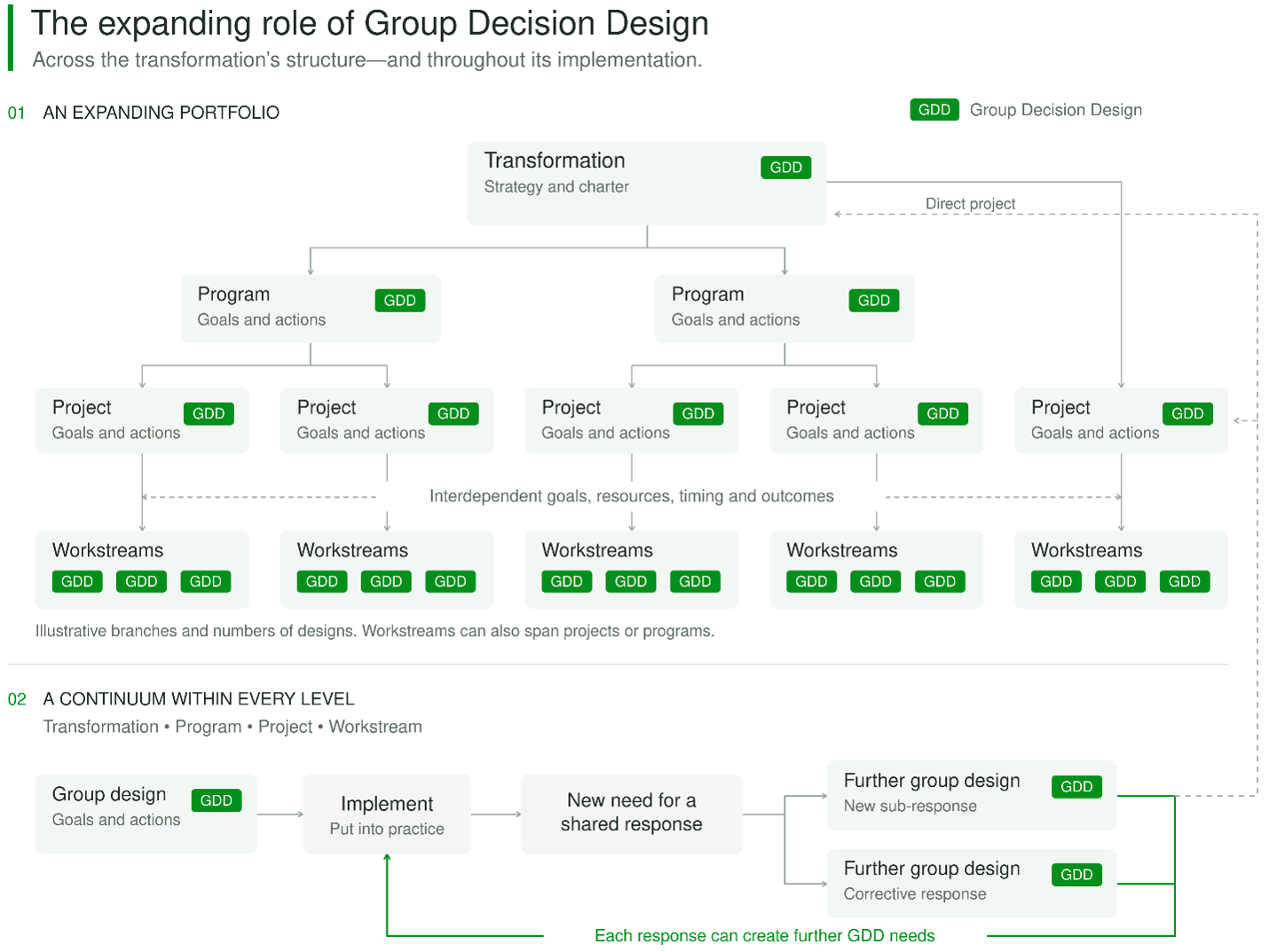
Design weaknesses cascade through the transformation.
Inaccuracy, incompleteness, and impracticality in each design cascade through governance and execution as an expanding thread of waste.
The 41 quality leaks therefore have a significance beyond any individual design. They affect a core activity on which the entire transformation repeatedly depends.
Transformation difficulties begin in design.
This decision design lens changes how transformation difficulties can be interpreted.
Some implementation issues originate in execution. Others appear during implementation but originated in a group decision design. Distinguishing them matters because improving execution cannot, by itself, repair the design.
Even when the familiar conditions for success are present—committed sponsorship, sufficient resources, capable people, supportive incentives, and disciplined delivery—their contribution remains constrained by the quality of the group decision designs to which they are applied.
Even perfect execution cannot make an incorrect assumption true, supply an omitted goal, or perform a necessary action that was never identified.
The resulting corrective action is commonly another group decision design.
If the underlying Group Decision Design capability remains flawed, it can produce a flawed solution to flaws it created.
Design flaws
Implementation difficulties
Corrective group design
Further flaws if the group design weaknesses persist
Group Decision Design must be a core transformation capability.
A transformation depends on the quality of the goals and actions groups repeatedly design, revise, and coordinate across its strategy, programs, projects, and workstreams.
It requires a common discipline for producing and maintaining the strongest attainable fit, feasibility, and alignment across the transformation’s interconnected designs.
Until the recurring weaknesses in that capability are addressed, a transformation will continue to incur avoidable losses even when its other capabilities perform well.
The organization’s capacity to transform depends on the process through which it repeatedly designs what happens next.
SchellingPoint makes that capability practical.
Studying the null case revealed there has never been a universal, publicly available Group Decision Design capability. So we developed one.
It provides a common vocabulary, framework, methods, and measures that leaders and managers can learn and apply wherever groups need to design a shared response.
Because people can overlook steps, apply methods inconsistently, or face limits in what they can process, we built safeguards against the quality leaks into software and AI.
Combined with optimization logic, these tools help groups directly identify the best possible goals and actions within a situation’s full solution space. No options needed.
The framework and software make Group Decision Design a practical management capability that organizations can own, use repeatedly, measure, and improve.
Leaders and managers need to be decision designers as well as decision makers.
SchellingPoint’s work combines more than a decade of teaching managerial decision-making at leading business schools with research into how groups develop goals and actions - and how flaws in those designs undermine implementation.
That work exposed a significant blind spot in managerial decision-making. Leaders and managers are taught to evaluate options and make choices. Yet designing a strategy, transformation, program, or project requires creating a response where no valid options exist. Organizations depend on this work, but lack a common discipline for performing it, assessing its quality, and improving it.
Our research examines that missing capability: the process groups follow, where design quality is lost, and what enables them to produce the strongest attainable combination of fit, feasibility, and alignment. We have translated the findings into a framework, methods, measures, software, and AI that make Group Decision Design a practical capability organizations can develop and own.
Explore how the research led to these insights, what they mean for your organization, and the solutions available to put them into practice.